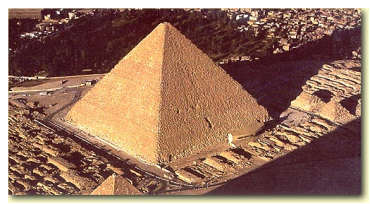
The Surprising Truth Behind the Construction of the Great Pyramids
The widely accepted theory-that the pyramids were crafted of carved-out giant limestone blocks that workers carried up ramps-had not only not been embraced by everyone, but as important had quite a number of holes.
According to the caller, the mysteries had actually been solved by Joseph Davidovits, Director of the Geopolymer Institute in St. Quentin, France, more than two decades ago. Davidovits claimed that the stones of the pyramids were actually made of a very early form of concrete created using a mixture of limestone, clay, lime, and water.
“It was at this point in the conversation that I burst out laughing,” says Barsoum. If the pyramids were indeed cast, he says, someone should have proven it beyond a doubt by now, in this day and age, with just a few hours of electron microscopy.
[…]
A year and a half later, after extensive scanning electron microscope (SEM) observations and other testing, Barsoum and his research group finally began to draw some conclusions about the pyramids. They found that the tiniest structures within the inner and outer casing stones were indeed consistent with a reconstituted limestone. The cement binding the limestone aggregate was either silicon dioxide (the building block of quartz) or a calcium and magnesium-rich silicate mineral.