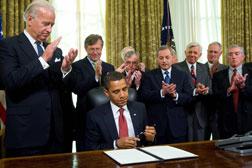
It has received the least attention of his first-day decisions, but President Barack Obama’s memorandum on reviving the Freedom of Information Act stands as the clearest signal yet that his campaign talk about “a new era of open government” wasn’t just rhetoric; it’s for real.
The key phrase comes right at the top: “The Freedom of Information Act should be administered with a clear presumption: In the face of doubt, openness prevails.”
Later in the memo: “All agencies should adopt a presumption of disclosure. … The presumption of disclosure should be applied to all decisions involving FOIA.”
Furthermore, “In responding to requests under the FOIA, executive branch agencies should act properly and in a spirit of cooperation, recognizing that such agencies are servants of the public.” In fact, “All agencies should take affirmative steps to make information public. They should not wait for specific requests from the public.”
This could not be clearer. The new president was calling for a complete reversal of the Bush administration’s directives on this matter—and a restoration of the Freedom of Information Act’s original purpose.
In other redefining government news from the Obamanation…
President Barack Obama is staffing his Justice Department with some of his predecessor’s fiercest critics, among them lawyers who were fired by President Bush or who quit jobs working for his administration.
Now, the opposition is in charge, and lawyers who spent years defining the limits of executive power will be helping wield it.
[...]
“I think they will be an irritant for Obama in the best possible way — they’re very honest lawyers,” said Rosa Brooks, a professor at Georgetown University Law School, where Lederman also taught. “When Dawn and Marty and David think that he is asking if he can do something that in their view pushes the envelope and goes beyond the bounds of what is legal, they’re going to say, ‘Sorry Mr. Obama, we think that would be illegal.’”
Honest lawyers at the Justice Dept. What will they think of next?



#60 – Paddy-RAMBO
>>Not really. But, it’s nice to document the nut cases.
You mean like the ones who claim to be peddling influence in “DC” and hobnobbing with international diplomats, when in real life they’re ringing up coaxial cables and banana plugs at Radio Shack?
#59–Musty==the issue of capitalization arises because you said acronyms were WORDS!! And I recognized the logical implications by way of set theory.
Words are subject to punctuation rules including capitalization:
http://en.wikipedia.org/wiki/Capitalization#Nouns
I note I have provided 3-4 weblinks that you choose to poo-poo but you provide none of your own. Been talking way too much to Paddy-Zero.
#56 Are you gonna keep at it? you want more?
“It can” is literlly translated as “se puede”. That is the strict literal translation. “Puede” could be used but is far from literal.
“Hecho” is not the past tense of “hacer”. It is its adjective or “participio” form of the verb, not a tense of the verb (not present, past nor future)
Here’s a little lesson for ya (BTW, the numbers imply the person the verb is being used as (first, second or third):
Hacer (past tenses only)
Pasado 1: hice 2: hiciste 3: hizo 1: hicimos 2: hicisteis 3: hicieron
Copretérito 1: hacía 2: hacías 3: hacía 1: hacíamos 2: hacíais 3: hacían
Pospretérito 1: haría 2: harías 3: haría 1: haríamos 2: haríais 3: harían
Pasado Subjuntivo 1: hiciera 2: hicieras 3: hiciera 1: hiciéramos 2: hicierais 3: hicieran 1: hiciese 2: hicieses 3: hiciese 1: hiciésemos 2: hicieseis 3: hiciesen
From the Royal Spanish Academy:
hecho, cha.
(Del part. irreg. de hacer; lat. factus)
These are abbeviations. “Part.” means “participio”; “irreg.” means “irregular” and “lat.” means “latin”
Takes an ignorant to say that “hecho” is a tense of the verb “hacer”. Takes an even bigger ignorant to say which tense.
‘puede ser hecho’?
Mustard, you’re embarrassing yourself, and making people question all the English you’ve been talking about.
#63 – ‘dro
>>“Hecho” is not the past tense of “hacer”.
Once you learn to read (any language), ‘dro, you will be able to discern that I never said “hecho” was the past tense of hacer. I said it is the PAST PARTICIPLE, coño. Cabrón. Pendejo. As in “no has HECHO nada”. Or as in “has HECHO la puñeta”. Or even as in “puede ser HECHO”, if you wish to translate “it can be done” literally from English.
>>“It can” is literlly translated as “se puede”.
No. It’s not. Literlly or otherwise. “Se puede” is third person singular conjugation of a reflexive verb. If you want to translate it, it would be “One can”, or “they can”, although there’s no literal translation into English for “se”. And the literal translation from English to Spanish of “it can be done” (with “it can” being non-reflexive third person singular) is “puede ser hecho”. Although that is not something that would ever be said (or “nunca será DICHO”, if you prefer), it is the LITERAL translation. If you don’t believe me, go ask a kindergarten teacher.
As to the rest of your copy ‘n’ paste exercise, pfffft. I was conjugating Spanish verbs while you were still sucking on your mama’s titty. Aspirations are great, but don’t go beyond your abilities.
Give it up now, ‘dro. This too, shall pass. The harder you hammer on your incorrect assertions, the more of a maricón you appear to be.
#64 – Lyin’ Mike
Read what I wrote. You are the one embarrassing yourself.
Better to embarrassed through ignorance than through lyin’, right Mike?
Oh, and ‘dro? Since you seem to like copy and paste from grammar texts, I’m surprised that you left out the rest of the “indicativo” and “subjuntivo” and “otras formas” sections, so here they are for your enlightenment. Note especially the last line. The formatting will be fucked up, but figuring it out will give you something to do, so you don’t embarrass yourself any further.
_________________________________________
Presente perfecto I have done he hecho has hecho ha hecho hemos hecho habéis hecho han hecho
Futuro perfecto I will have done habré hecho habrás hecho habrá hecho habremos hecho habréis hecho habrán hecho
Pluscuamperfecto I had done había hecho habías hecho había hecho habíamos hecho habíais hecho habían hecho
Pretérito anterior1 I had done hube hecho hubiste hecho hubo hecho hubimos hecho hubisteis hecho hubieron hecho
Condicional perfecto I would have done habría hecho habrías hecho habría hecho habríamos hecho habríais hecho habrían hecho
Subjuntivo
Presente I do, am doing haga hagas haga hagamos hagáis hagan
Imperfecto2 I did, was doing hiciera hicieras hiciera hiciéramos hicierais hicieran
Futuro1 I will do hiciere hicieres hiciere hiciéremos hiciereis hicieren
Presente perfecto I have done, did haya hecho hayas hecho haya hecho hayamos hecho hayáis hecho hayan hecho
Futuro perfecto1 I will have done hubiere hecho hubieres hecho hubiere hecho hubiéremos hecho hubiereis hecho hubieren hecho
Pluscuamperfecto3 I had done hubiera hecho hubieras hecho hubiera hecho hubiéramos hecho hubierais hecho hubieran hecho
Participio pasado done hecho
Oh, fer Chrissakes, how did an article titled “Obama Is Reversing Bush’s Closed Government Policies” degenerate into a ridiculous discussion of abbr. vs. acronyms? Jeez, guys, go to Cage Match and continue this topic.
NATO is, BTW, an acronym, not an abbr. for North Atlantic Treaty Organization. Defined. Done. Over. Out.
Bobbo and ‘dro,
Please, accept that Mustard knows what he talks about.
Lyin’ Mike,
I think you have been thoroghly owned on this one.
Cow-Paddy, Ignorant Shit Talking Sociopath, Retired Mall Rent-A-Cop, Pretend Constitutional Scholar, Fake California Labor Law Expert, Pseudo Military Historian, Phony Climate Scientist, and Real Leading Troll Extraordinare,
You are still an asshole who hasn’t a clue about this or, for that matter, a clue on anything.
# 69 Mr. Fusion said, …
Mr. Fusion. You’ve already been registered in the NeoLib Psycho registry. More posts won’t get you multiple listings…
$69 No, he doesn’t. He’s just a spoiled brat that cannot accept he is wrong.
#71 – ‘dro
Lead by example, ‘dro. Accept that YOU are wrong.
More war crime atrocities committed by the Obama regime:
Karzai’s latest criticism follows a Saturday Jan 24 raid in Laghman province that the U.S. says killed 15 armed militants, including a woman with an RPG, but that Afghan officials say killed civilians.
Two women and three children were among the 16 dead civilians, Karzai said in a statement.
That was the way it was meant to be. Was it not ?
#57 – bobbo,
I tried several definite acronyms on merriam webster. Not a single one of them was listed as an acronym. I think they don’t really make a distinction for that category, check scuba, laser, and snafu for references.
I think the real answer is that all acronyms are indeed abbreviations. Not all abbreviations are acronyms. Typing the word in all upper case has nothing to do with it, as far as I can tell. In fact, when an acronym goes from all caps, as laser, scuba, and radar all were at one time, they become ordinary words. Some ordinary words may also be acronyms, as evidenced by this. However, it does not mean they are not acronyms. When one sees the derivation of the word, the history is still obvious.
So, NATO is an abbreviation that is also an acronym, as is FEMA, because both are typically pronounced as words. I have never ever heard anyone spell out NATO. I have never ever heard anyone attempt to pronounce STFU. (Although, for grins, I did try it in my head just now. It didn’t go well.)
So, I would personally not dispute that NATO is an abbreviation any more than I would dispute that a square is a rectangle. However, when looking at a perfect square, I will say that I always call it a square and only acknowledge its generality as a rectangle when pressed. Ditto for acronyms. I would acknowledge them as a form of abbreviation, for indeed, they do abbreviate the concept into a new shorter word. But, when I look at laser or NATO, I call both acronyms.
If you choose to look at a square and call it a rectangle, you will not be incorrect. But, you may sound a tad silly.
#62 bobbo, that wikipedia link you provided has the following to say in the section under the heading of “Nouns” (which is a subset of words, I’m sure you’d agree):
“While acronyms have historically been written in all-caps, modern usage is moving towards capitalization in some cases (as well as proper nouns like Unesco).”
So it would seem that according to the material at the link YOU provided, acronyms are indeed words, although they may be used with special capitalization conventions, directly contradicting your silly little ramblings in #57 to the effect that full capitalization somehow implies non-word status.
My advice is, next time find material that supports your position, and find some medication that helps you stop being such an ass.
Kudos for your patience, Mister Mustard.
#75 – Scottie
>>I have never ever heard anyone attempt to pronounce
>>STFU. (Although, for grins, I did try it in my head
>>just now. It didn’t go well.)
I had never heard anyone attempt to pronounce USPS. After a particularly unpleasant failure-to-deliver experience with the USPS, I referred to them as YucePiss to a friend of mine who works for the Postal Service.
He liked it.
Watch for YucePiss in upcoming television and radio ads for the post office.
#72 Sometimes, I follow someones elses. Keep trolling.
At Post #30 I thanked Musty for teaching/reminding me of something then I went on to what Musty himself could learn if he wished–that the relationship between abbreviations and acronyms is “dynamic.” While many things are set in concrete, others are not. Always good to know when to be flexible. In fact, we would all benefit if we started with flexibility before we got all calcified.
In that I learned and Musty did not, I’ll just have to give my self another point.
Very productive day.
You know, reading a thread like this — hell, most threads on any post on this blog — convinces me that if early man knew what would become of the human race by developing speech and language and writing he would have gladly gone extinct.