
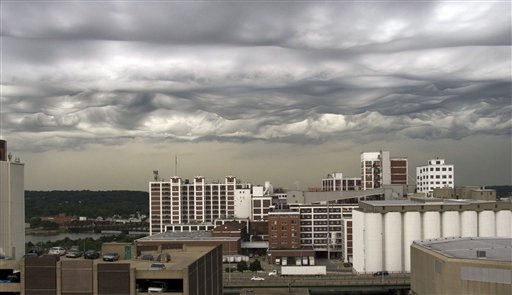
MSNBC – Looking out the 11th floor window of her law office, Jane Wiggins did a double take and grabbed her camera. The dark, undulating clouds hovering outside were unlike anything she’d seen before.
“It looked like Armageddon,” said Wiggins, a paralegal and amateur photographer in Cedar Rapids, Iowa. “The shadows of the clouds, the lights and the darks, and the greenish-yellow backdrop. They seemed to change.”
They dissipated within 15 minutes, but the photo Wiggins captured in June 2006 intrigued — and stumped — a group of dedicated weather watchers who now are pushing weather authorities to create a new cloud category, something that hasn’t been done since 1951. Breaking into the cloud family would require surviving layers of skeptical international review. Still, Gavin Pretor-Pinney and his England-based Cloud Appreciation Society are determined to establish a new variety. They’ve given Wiggins’ photo and similar pictures taken in different parts of the world to experts in England, and are discussing the subject fervently online.
“They (the clouds) were the first ones that I noted of this type and I was unsure which category to put them under,” said Pretor-Pinney, author of “The Cloudspotter’s Guide.” “When we put pictures up online we list the category, and I wasn’t sure how to categorize it.” Some scientists are skeptical. They argue that researchers who have long watched the sky haven’t seen anything distinctly new for decades. There are three main groups of clouds: cumulous, cirrus and stratus. Each has various sub-classifications built on other details of the formation.
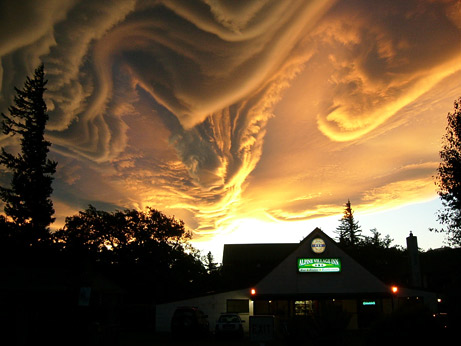
Brant Foote, a longtime scientist at the National Center for Atmospheric Research in Boulder, Colo., said the clouds photographed by Wiggins already fit into the existing cumulous classification. But Pretor-Pinney, who never studied meteorology, believes the clouds merit their own cumulus sub-classification. He proposes they be called altocumulus undulatus asperatus. The last word — Latin for roughen or agitate — is a reference to the clouds’ undulating surface. “Not necessarily gentle or steady, but quite violent-looking, turbulent, almost twisted in its appearance,” he said.
The group has compiled several photographs documenting the formations from the billowy, rolling clouds shot by Wiggins in Iowa to ones from New Zealand that were much more menacing, hanging lava-like in the sky.
Foote said it would be “very unusual” for such a formation to be recognized as a new variety of cloud.
“People have been looking at clouds for hundreds of years and the general cloud classification is well defined,” Foote said. “It’s not as if someone discovered a new plant in the Amazon. It’s what you’ve seen every day. There was no atmospheric condition that caused a new kind of cloud to form.”




Mr Fusion, I’m pretty much as left wing as you can get on most issues (except tasering kids at school. They shoudl ALL be tasered at the start of each day if you ask me) so it pains me greatly when my comments appear to come from the right.
It also makes me less likely to donate to John’s NoAgenda podcast in case it starts leaning to the right as well.
I’ve seen those types of clouds all the time.
Sounds like the woman never really looked up until recently.
Most people don’t know what the sky is until you ask them and stare up.
Cursor_
“Greenish Yellow backdrop”
.That’s a hint…Tornado
Typing on the Right issue:
From another blog story, Jägermeister found the problem:
“Jägermeister said, on June 13th, 2009 at 6:37 am
“#2 – RTaylor – I’m not writing in Hebrew.
“Why is the cursor fixed on the right margin?
“Because John’s code monkey doesn’t know how to maintain a website.
“Shut off JavaScript and the editor will be back to normal. The easiest way is to install NoScript if you’re using Firefox… it will allow you to choose which JavaScripts that are executed (in this case “dvorak.org”, but you might want to shut off “google-analytics.com” and “googlesyndication.com” as well. If a video isn’t showing on the site, just turn on JavaScript to watch it, then shut it off again. It’s easy.”
Using NoScript ‘breaks’ too many sites for me to use it to fix just this single badly coded site.
Why is the old system not used? It seemed just fine.
I’ve seen those too. They are weird lookin but leave it the nutt jobs to make it out to be a brand new end of the world all over again.
#36 – Zybch – Using NoScript ‘breaks’ too many sites for me…
So, don’t disable those sites.
–the first pic looks photo shopped..
as for the rest..
This is probably what happens when two countries turn on their HAARP arrays and target the same area for atmospheric heating..(without consulting each other first)
aside from that..i’ve ran across these clouds in the recent past. bewteen november 2008 and march 2009, clouds similar to these appeared over the NYC area.
this sent me on a hunt to see if they had been cataloged before..
the closest i could find were stretched or skewed Lenticular clouds. <-google that
while most descriptions say they are natural forming, i have a hard time believing that.
anyway… on the hunt i found an outstanding cloud website
Nasa’s slant on it can be found here. scope the gallery there..you will find many fantastic formations.
if natural, i'm sure we'll start seeing more of this as the magnetosphere changes (shrinks) over the next few years..
-s
#39 you’re right, they are lenticular clouds.
Your HAARP array comments are way out of whack though.
First, the ionosphere is 85,000m and higher, and no clouds exist above 40,000 feet, except the top of a TCU cloud, which can protrude a thousand feet or so, and that only happens in the kind of storms you hear about on the news, shortly before property insurance rates go up.
Second, although there are more than one ionospheric heater, there is only one HAARP array in the world.
Third, you cannot create clouds by heating air. Only by introducing moisture or cooling air.
Fourth, the wavy pattern in lenticular clouds exists because of a ‘buoyant’ stream of fast-moving air that is bouncing up and down the way a basketball would if you threw it in the water.
I’ve looked at clouds from both sides now
From up and down, and still somehow
Its cloud illusions I recall
I really don’t know clouds at all
,Joni Mitchell
Hmmm the effects of chemtrails? Or perhaps the Pleidians smoking from their intergalactic bong?
Aren’t those the clouds the aliens use to hide behind? 🙂
#40 hate to break it to you, but at least 5 of the G7 nations have resonant technology.. we more or less borrowed the tech from Russia. (well in truth, we collaborated with them)
-more or less an open secret.
Russia has almost a 20 year jump on us in experience with EMR/EMF/ELF/VLF energy and radio waves.
they offered us several decades worth test data (on 30k+ people) in the early 70’s of the effect of EMR (electromagnetic radiation) on human behavior, stress, cell damage, cancer and host of other issues, which of course we politely declined. -them being communists and all.
(see project sanguine for some of our early work. – Robert O. Becker has testified to the biological hazards/effects)
-anyway.. they are crucial to hi-tech research on everything from weather control to military EMR weapons..kinda like a must have these days..
it’s really simple stuff, actually.
you can see similar energy bursts (and effects) on weather radar maps from time to time..
the theory of operation has been around since the late 1800’s…yada yada..
so no..there isn’t just one.
lastly, traveling down this rabbit hole will lead you to the fact that a lot of modern science is based on total hogwash.
happy discovery!
-s
Remember, these clouds often last less than 30 minutes, so it shouldn’t be surprising that more people are photographing now than at any time in the past. We used to have to run and find our cameras, check to see if we have film, check for lighting—–then take a picture. Now, we pull out our cell phones and snap.
It’s not a new cloud, but it will be photographed more often, especially since people will now look for it.
Paul, http://cloudyandcool.com/
Its an asperatus cloud. And storms dont likely follow as someone said. They usually happen in the mornings and mid day. They tend to dissipate in about 15-30 minutes within forming.