ars-copy-copy

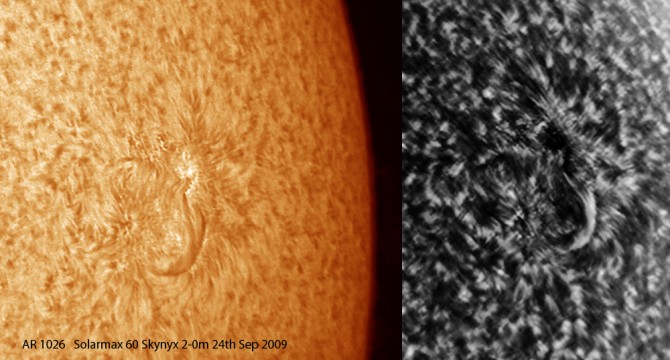
WIRED – Two sunspots are visible on our star’s face for the first time in more than a year, possibly ending an unexpected lull in solar activity.

Solar flares rise and fall on an 11-year cycle, so scientists thought sunspot activity would pick up some time in 2008. It didn’t. And this year has been quiet, too. No sunspots have been visible on the sun for 80 percent of the days this year.

Sunspot activity is correlated with the total amount of energy we receive from the sun. If the sun’s activity were to change remarkably, it would have an influence on global climate. So, in the context of climate change, the fact that the current solar minimum has been the longest and deepest in more than a century has been of special interest.

In May, a big sunspot seemed to augur a return to normal, but it faded away and sunspotless days returned. The latest activity might not mark the end of the solar minimum, however. People have been counting sunspots since Galileo first observed one in the early 17th century. Through the 28 documented cycles, stretching from 1745 to today, some variation in cycle length has been observed.

Maybe NOW we can get a little of that global warming… and winter won’t suck after all.



  1. MikeN,

    Rereading both your article and the updated hockey stick article, they seem to be completely unrelated. Perhaps you didn’t read even the abstract on the new hockey stick article. Since you missed an important point, I will quote the abstract in its entirety here (emphasis mine).

    Following the suggestions of a recent National Research Council report [NRC (National Research Council) (2006) Surface Temperature Reconstructions for the Last 2,000 Years (Natl Acad Press, Washington, DC).], we reconstruct surface temperature at hemispheric and global scale for much of the last 2,000 years using a greatly expanded set of proxy data for decadal-to-centennial climate changes, recently updated instrumental data, and complementary methods that have been thoroughly tested and validated with model simulation experiments. Our results extend previous conclusions that recent Northern Hemisphere surface temperature increases are likely anomalous in a long-term context. Recent warmth appears anomalous for at least the past 1,300 years whether or not tree-ring data are used. If tree-ring data are used, the conclusion can be extended to at least the past 1,700 years, but with additional strong caveats. The reconstructed amplitude of change over past centuries is greater than hitherto reported, with somewhat greater Medieval warmth in the Northern Hemisphere, albeit still not reaching recent levels.


Bad Behavior has blocked 26366 access attempts in the last 7 days.