
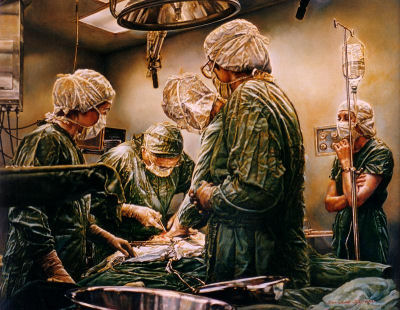
Health reform from my side of the surgery table
Forty years as a surgeon in university and community hospitals gives some authenticity for the following reflections regarding the failings of our health care delivery. Partisan rhetoric has led to shouting matches rather than reasoned choices, while the most fundamental issue in health care reform has yet to be stated: should health care be continued as a profit-driven enterprise? If a problem well-stated is a problem half solved, a clear answer will allow for progress. Here are the some of the problems I have observed:




I think it’s very telling that 90% of the posts related to this article are not related to the content of the article. The article is about health care, not democracy v. republicanism. This says to me that the good doctor’s statements are true and no one can come up with any arguments to the contrary. It’s a very good article.
#23, bobbo, my dear friend,
THE BEST argument that the USA is not a democracy is the Constitution that formally and expressly set up a Republican form of government split between three branches to act as check and balance against excesses along with the Bill of Rights to mitigate against mob rule.
A republican form of government has nothing to do with being a democracy. Many republican governments have been dictatorships*. The polar opposite of a republic is a hereditary monarchy where the sovereign makes the rules and laws. A republic is only one FORM of government. A Parliamentary system is most popular and seems to work the best.
* – I can’t think of any republic other than the U.S.A. that is a still a democratic republic. Every other one I can think of either fell into dictatorships or collapsed into chaos.
No matter what you call it, America is a Republic and a Democracy. And note, the Constitution does elude to “elections”.
#27, Guyver,
14, Fusion, Under Article 1 Section 3 of the Constitution, Senators used to be selected by the state legislators / governor of the states they came from. This is why Senators today serve a six-year term instead of a two-year term.
OK, so what is your point? As far as I know none of the colonies wanted to become a monolithic monarchy dictatorship? All of them had, following the British tradition, bicameral legislatures.
The Senate was originally patterned after the British House of Lords. Because even if there was a radical shift in the Parliament, the House of Lords added some stability and continuity in the government. The same was desired in the new country being created. That is why Senate terms are staggered so only 1/3 are ever up for re-election at any one time.
But those appointing them? They were elected by the People to represent the People. They weren’t the King’s representatives appointing someone to represent the King.
*
17, Fusion, The fore-fathers knew that a true democracy was not a good idea for the very reasons LibertyLover has stated in that the majority would outvote the minority in every case of a true democracy.
No, they didn’t give true democracy of one person one vote for a very simple reason. They didn’t believe in it. Their attitude (with exceptions) was only those who owned property were significantly concerned enough to warrant a vote or say in running the country. Don’t forget, the vast majority of revenue for all levels of government was land taxes.
Even though the new America decried the chains of British rule, it was still a class based society. Blacks were slave material and even free(d) blacks had fewer rights that whites.
Women were not only denied the vote, they were expected, often by law, to be subservient. A woman’s property was almost always controlled outright by the husband.
Tradesmen were beholden to their masters with no or little say. If an apprentice ran away, he could be arrested as if he were a common slave.
Enough history lesson, this isn’t the place to write something so basic it is taught in most every college entry History course.
But don’t start reinterpreting something so basic and adding new meanings that fit your wish list. The Constitution was worded and written the way it was because that is the way they thought 225 years ago. We don’t think like that anymore. We, as a society, have progressed. We removed the chains that late colonial society had and fit it all into the Constitution.
*
The fore fathers decided to have a Democratic Republic instead due to the very shortcomings of a true democracy. This is what you’re referring to as a “Constitutional Democracy”.
You are taking a modern term and using it to reflect what the original framers wrote. They never intended to have a “Democratic Republic” as that very thought was not yet known.
Most of the Congress had come from the colonial legislatures. There they had seen their collective will overturned by the British Governor. Their sole aim was by putting the limits of power in writing, everyone would know up front what could and what could not be done. In short, they did not want the whims of a monarchist to over rule society’s collective desires.
The problem most LIEBERTARIANS have is thinking with a modern mindset about what the original framers meant. Inevitably they are wrong.
the surgeon makes excellent points, but runs smack into a huge problem that I have yet to see a good solution to; personal choice and liberty in lifestyle. Shifting the burden of cost to prevention rather than intervention would do a great deal, but people in the US take piss poor care of themselves (working in cardiology, I see this firsthand a lot). Unless you want to lay down some seriously heavy-handed nanny state totalitarianism there is no actual way to apply effective prevention upon the general public. Because of this, you have (broadly speaking) two choices. You can either accept the system basically as is, in which people are largely responsible for their own poor health and largely responsible for paying to fix their self-inflicted problems, or you can advocate controlling authoritarianism over the way people live. Seriously, given the cost burden of intervention it is not economically feasible to socialize healthcare without taking drastic steps to control the way people live. Self-care deficit is a huge damn problem and not one easily overcome.
#35, The problem most LIEBERTARIANS have is thinking with a modern mindset about what the original framers meant. Inevitably they are wrong.
And if you would respond in kind to your challenge, I would teach you where you are wrong here. Do you like going through life being wrong all the time?
Why would you sacrifice others to save your wife?
#36
do you know how many persons in this nation would LOVE to have a full diagnostic and ALL the tests needed to TELL them whats happening to THEMSELVES, every year?
Do you understand how much this costs??
DO you know, that the DOCTOR must justify this, BEFORE it can be done, to ANY person. And the odds are it WONT be accepted.
Let me add, that a FULL diagnostic would probably take 2-3 days PER PERSON to complete..
YOU could actually TELL you if you are being killed by pollutants in the job place BEFORE you were heavily exposed..
YOU could discover if someone was wearing out their KNEE PADS.
YOU COULD CATCH the start of most arthritis, before it becomes worse, and correct the diet to HELP.
SO WHAT it might cost $10,000 and you pay 20% as a deductible..($2,000)(do you have an EXTRA $2,000 per year floating around?).
PLEASE, go work for a low paying job, and tell me how it works out..(<$12 per hour)
Please go work seasonal work, and tell me how it works out..
Please go work at a store that HIRES single income females with CHILDREN..as their FIRST choice.
Please go find a hose that rents for <$600 per month..its the ONLY way you will save money.
PLEASE go and try to live off $5 per day in food.(counting GAS to get to the store 20 miles away)
ANd when you need to use your credit card to make ends meet…TRY to pay that 15% (+) interest…
AND PRAY that your children dont have an accident, and that YOU DONT GET SICK..
#38
I’m sorry, but I’m having a hard time making the connection between what I said and your response.
I was making the point that the doctor is very much correct in his notion that frontloading the costs into screening and prevention is a fantastic idea. In any branch of medical practice it is infinitely preferable to prevent a medical condition rather than to treat it acutely.
However, my dissenting point is that we are facing an issue of extremes here and I don’t see an effective middle ground solution. Either we keep the system as is and let the payers get the treatment, and in the process respect personal liberty in lifestyle and health decisions. Or, we socialize and resort to prevention and screening. The problem is, the greatest threat to American health is our own lifestyle and habits. Fully socializing medicine (without resorting to rationing) absolutely requires that we take a stronger authoritarian stance on how people live and what they eat and put into their bodies. If you attempted to simply absorb the cost of universal healthcare in America without rationing or lifestyle controls it would not be sustainable. Our lifestyle is simply too poor to do so. It truly is a testament to the quality of our care that we have such a high life expectancy, because believe me, when you work in healthcare you can see firsthand that the vast majority of people do NOTHING to maintain their own health.
Economically, we could make it work here in the US, but to do so we would have to resort to much heavier-handed governmental controls into people’s lifestyles. IT CAN WORK, but the means by which it can may leave a bad taste in many mouths.
39,
“I was making the point that the doctor is very much correct in his notion that frontloading the costs into screening and prevention is a fantastic idea.”
and my point is back…The costs of going to a Doctor for full diagnostics Every years are prohibitive, to ANYONE not making good money.
they cant afford time off.
They cant afford the 20% deductible.
The Insurance agency WONT allow it.
“However, my dissenting point is that we are facing an issue of extremes here and I don’t see an effective middle ground solution.”
I can give you a choice.
1. STOP paying for your representatives MEDICAL.
2. FORCE upper management/rich to PAY INTO THE SYSTEM. MOST dont. they pay into private systems. and when they DO pay into the system there is a LIMIT that they pay, Unlike those in the bottom, who pay a Percentage of income.
3. RESTRICT MAX PAYMENTS in Social security.
Pres Ford was making over $300,000 per year after retiring.. after spending most of his life in Public office and the military..
4. did you know that BEING a representative they have a RETIREMENT fund, that gives back EQUAL to your wages?? MEDICAL is free, transportation is a WRITE OFF, ANYONE you hire for assistance, is a write off? Cars, planes all of it can be written off.
AS their EMPLOYER, dont we have a SAY in what they are SUPPOSED to get?
5. MAKE their medical EQUAL TO EVERYONE ELSE’S.. If we are getting decent coverage and protect, ISNT it as good as theirs?? AS you mentioned, PREVENTION is better then dealing with it AFTER the damage.
Here’s a radial idea. Health Care (in America) should be financed by tax dollars. While WAR should be a profit-driven enterprise (it already is, but paid for by federal taxes and deficit spending). We can tax ourselves into ruin, to fix all the world’s problems with US troops and military hardware. Nation building, peace policing, and conflict resolving. But none of this is every voted for, by the people who end up paying for it. We’re treated as just too stupid to know what’s the right course to take.
Meanwhile, when it comes to things Americans could all benefit from. Like better education, and health care. These get little or no tax dollars, compared to WAR spending. And politician who had no problem voting in favor of WAR spending, continue to bicker across party lines, about what form of health care reform they’re in favor of. They always know how to vote for the wrong things (War, NAFTA, etc). But give them a common good issue, and their tiny little heads explode. Face it, the US is run (or ruined) by those who cave in to war profiting conglomerates. And to exploitative health care insurers. Who don’t want what they’ve carefully lobbied for to ever be changed.