Courtesy Paramount

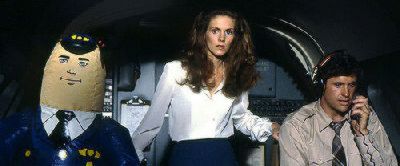
This is your Captain speaking…

Two airliners landed at Reagan National Airport near Washington without control tower clearance because the air traffic supervisor was asleep, safety and aviation officials said Wednesday.

The supervisor — the only controller scheduled for duty in the tower around midnight Tuesday when incident occurred — had fallen asleep, said an aviation official, who spoke on condition of anonymity to discuss the incident.

The National Transportation Safety Board is gathering information on the occurrence to decide whether to open a formal investigation, board spokesman Peter Knudson said.

“I’m not sure that in all the years I’ve been flying airplanes that I can recall coming into a major airport and I couldn’t get hold of a controller in the airport tower,” said aviation safety consultant John Cox.

There’s nothing in the FARs (Federal aviation regulations) to cover this situation. Controllers at other facilities can advise but not provide landing clearance. The pilots were on their own. It’s a good bet they won’t be hassled for landing without clearance.



  1. RH says:

    Currently (according to the NTSB and numerous FAA safety programs, in recent years), the greatest danger facing airliners is a collision — not in the air, but with another airplane or other entity (vehicles, construction/maintenance equipment, etc.), on the GROUND, or immediately during takeoff or landing.

    (Several recent crashes, and some historic ones — including the worst airline disaster ever, at Tenerife — have happened this way.)

    Lots of good a regional controller in a remote facility is going to be for preventing THAT.

    In darkness, an airliner approaching from miles away at over 100 mph is NOT in anywhere nearly as good a position to assess the dangers on the field as a pair of eyes in the tower, immediately overlooking the airport — monitoring, surveying and controlling its familiar turf.

    There’s a REASON we put people in towers, overlooking the airfield, and directing its traffic. And there’s a reason why we can’t accept a situation — especially in the heat of the nation’s capital — that addresses that danger.

    Planes DO run into each other, especially at/on/immediately-around the airport. Tower controllers are the only people well-positioned to prevent that (ESPECIALLY at NIGHT!)

    Anyone who has performed a night approach to a runway in a brightly lit major city, with the glare of countless extraneous lights cluttering and undermining one’s vision, knows he shouldn’t be making cocky assertions that he’s a better judge of the dangers on the dark and distant runway than a vigilant, expert controller on the scene.

    And there’s another issue, too: The terrorist threat.

    During the Bush years, there was a hyper-paranoia (not entirely unjustified) about how terrorists could use the pretense of approaching for a landing at Reagan National as a cover for approaching the Capital, and diverting to attack any of the dozens of national government headquarters facilities that are within seconds’ flying time of Reagan National — the White House, the Capitol Building, the Supreme Court, the Pentagon, etc., etc.

    Takeoffs from Reagan National could also be convenient for that nefarious purpose.

    How many seconds would it take a controller to summon an F-16 interceptor? A turning airplane is instantly apparent to a vigilant tower controller. But how long would it take a distant regional controller, staring at a tiny blip on the screen, to even realize that a pilot had diverted straight towards the Capitol?

    And if the regional controller mistakenly assumes an awake airport tower controller, would the regional controller have even bothered to pay attention to whether or not local airport traffic was slightly off-course?

    As a result, of the danger of terrorist exploitation of Reagan National, there was (supposedly) a extra-detailed FAA / Homeland Security / Defense Dept. system established for screening aircraft, pilots and passengers for flights into Reagan National — but it largely hinged on the assumption that SOMEONE in the tower would be watching and closely tracking each of these flights as they came and went, and making sure the RIGHT people were coming and going — and not the WRONG people.

    That’s not what regional controllers do.

    That’s what TOWER controllers do.
    When there’s enough of them,
    and they’re all awake.

    To excoriate this one controller as the fall-guy for something utterly predictable (a lone person on an overnight shift inadvertently falling asleep) is to ignore all the evidence and common sense about what is CERTAIN to happen from time to time.

    Even the airline pilots are starting to admit that they occasionally nod off in the cockpit on long, boring flights. The safety net here is a co-pilot (not to mention an autopilot, and normally a few flight attendants who are likely to raise alarm if the plane goes wildly off course. And, oh yeah, controllers on the ground who can shout at them through the headphones.)

    The problem is a government and airline industry (and general aviation community) trying to do air traffic control on the cheap.

    There are some jobs you don’t entrust to ONE person. That includes flying an airliner — and controlling a major, national-security-sensitive airport.


Bad Behavior has blocked 26061 access attempts in the last 7 days.