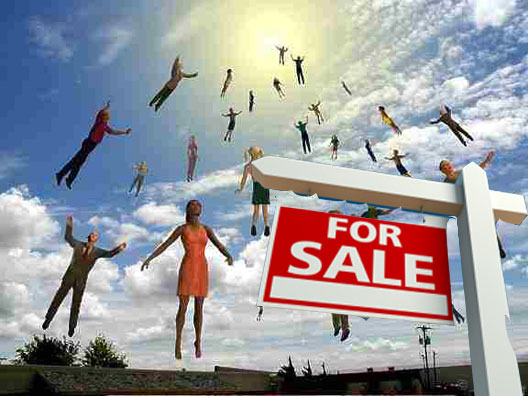
There’s just something funny about someone spending time figuring this out.
The first problem with calculating the effect of a Rapture on real estate lies in determining how many people would actually disappear. Predictions range from 144,000 — about 0.0024% of the world’s population, to about half of us, the amount of people who were left behind in Tim LaHaye’s series. However, even if an average of 50% of Americans manage to stay around after Rapture, it seems likely that the post-Rapture numbers would vary wildly from region to region.
[…]
In New York City, for example, a 49% drop would reduce the city’s population to 1910 levels. In the short run, this would cause property values to plummet in the city, but the effects would quickly spread beyond mortgages and rents. […] Effectively, he argues, this would turn the clock back 40 years or more, to an era in which low rents made it much easier for middle-class residents to choose neighborhoods based on preference, not price.Outside of urban centers, Schiller suggests, Rapture would likely be a final nail in the foreclosure coffin, as “People holding on by their fingernails would be more willing to let go of their houses.” […] Municipalities, facing large stretches of empty houses, might be inclined to adopt the solution that Detroit and Youngstown, Ohio, are currently pursuing: “tearing down old homes and seeking adaptive uses for the land.”
This is assuming a post-Rapture world in which the political and economic systems would remain relatively stable — admittedly, a somewhat unrealistic expectation. For that matter, it seems likely that the remainder of humanity, having seen half of its number called into heaven, would be inclined to draw more closely together, further accelerating urbanization. However, even if everything else stays the same, one thing is clear: The Rapture would have an apocalyptic effect on real estate.