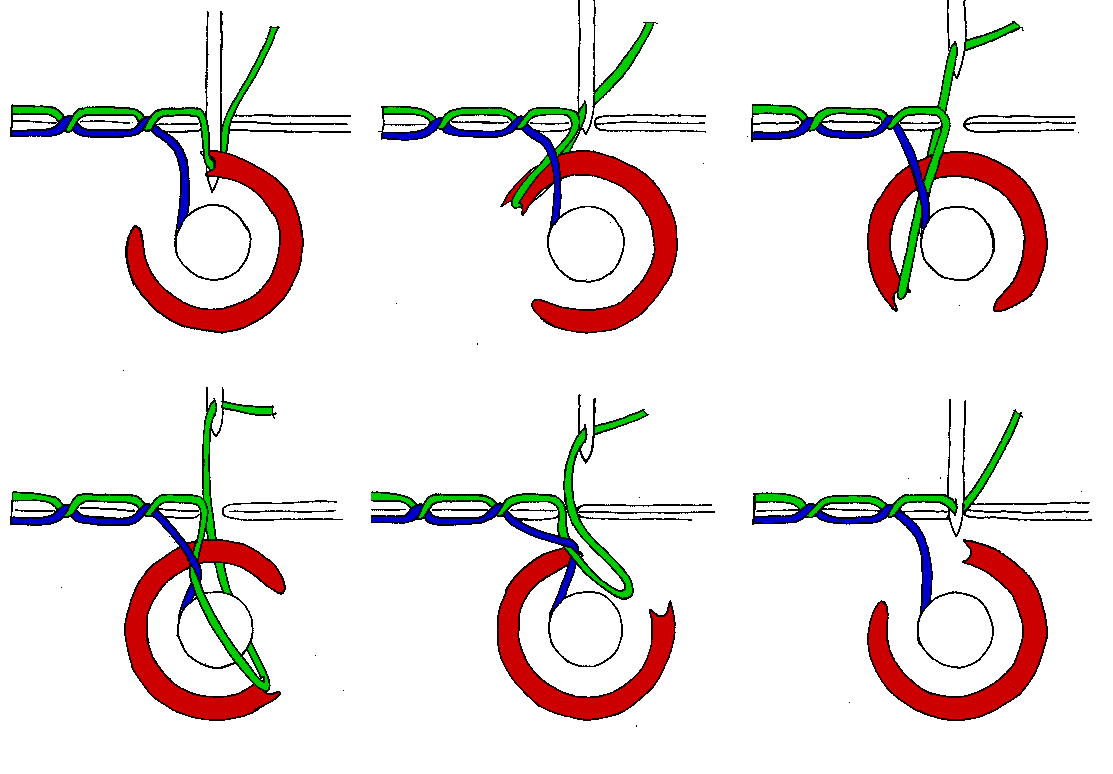
Have to say it always seemed like magic watching one work. Funny how a simple graphic can clear away the fog.
Reposted to top.

The amazing thing is that it actually works. Every single time that thread is caught and wrapped around. Wow.
Also amazing that it was invented in 1846.
A great story, I had always wondered how it worked my self
As Kurt Vonnegut said, “Sew it goes.”
I found the comments most amazing…
I started sewing with a sewing machine when I was 7 years old (54 years ago) and figuring out how it worked was one of the very first things I did.
It’s difficult to believe people have so little curiosity and are so willing to accept that things just work by “magic”!
One of the Junkyard wars teams made a great video about this several years back, using their bodys as parts of the sewing machine:
http://www.youtube.com/watch?v=bAhmYzmkvcY
If you grew up in the New England factory town which was home to Singer Sewing Machine and its founder Elias Howe – honored with a statue on the harbor, young males of the horny persuasion were wont to use the inevitable one-liner on females of any persuasion:
“Let’s go down to Seaside Park, tonight, and I’ll show you Howe – standing up!”
Somebody explain how the string makes it through the shaft that spins under the material.
#5
Wow! Only a mind as great as you can find amazement in the fact that some people aren’t curious enough to unravel the workings of a machine they’ve never had occasion to use. Your just as precious now as you were at 7.
Somebody explain how the string makes it through the shaft that spins under the material.
It’s not a shaft, it’s a reel containing the second thread (blue in the diagram) and mounted at a slight angle so that when the green thread is caught it’s initially behind the blue one. As the catcher (forget its proper name) revolves, the green thread is shifted to the other side of the reel and then released.
#8–The thread does not go thru the shaft but rather it is wrapped around the “bobbin” and simply unspools as the shaft/bobbin turns. As it is “underneath and not seen, it can be whatever thread is left over.
I always wondered if the fridge light stays on when I close the door
The bobbin thread should be the same thread as used on the spool. Same size and weight or they will not stitch properly.
#1
Anyone that has ever used a sewing machine knows that it does not work every single time. Most of the time, yes. But on the few occasion I have tried to use one of these beasts, there have been many expletive laced conversations between me and machine when the bobbin gets screwed up.
#10
That is clear from the animation. If you look at the “catcher” when at the bottom of the rotation, one green string is on the front side of the real, and one green string behind (like a jump rope). There has to be a shaft on the backside to rotate the assembly… Therefore It would seem that the green string on the back side is cutting through the shaft.
I’ll have to tear one apart to see this in action!
#16, I don’t understand what you’re doing.
I agree with #15… is that right? now I’m curious!
I just looked and this is not how it works (at least not on the one my wife owns)!
It’s a bit complicated to explain but there are a couple of notes:
1) The “catcher” does not rotate 360 Degrees- it reciprocates in a half moon arc (most important fact).
2) The fabric should be at a right angle to the direction the illustration is showing.
3) The shaft on the far side is set away from the “bobbin,” and an arm is attached that rotates the outside of the mechanism,and therefore does not come into contact with the string because of the reciprocation.
Lesson for the day-the “tubes” are not always correct!
As a child, I asked my mom how a sewing machine worked. She replied, “Gary, it is so complex and wonderful that we can’t possibly understand it, and we should never question its place in our lives.”
This wasn’t the only time I got that answer
Gary, your mom is a very smart woman. Except that she raised a dangerous infidel. Anyway…
They can be turned manually and you can watch it stitch at whatever speed you need to get the picture.
“I just looked and this is not how it works (at least not on the one my wife owns)!”
That’s because it’s different than the original Singer mechanism, which is the one shown, and for well over a century, the only one that worked reliably.
“2) The fabric should be at a right angle to the direction the illustration is showing.”
HUH??
The graphic shows the fabric lying horizontal. As it does on ALL sewing machines except special purpose ones that are made to sew horizontal things in place. It has to lie flat or gravity would fuck up the whole arrangement.
“Lesson for the day-the “tubes” are not always correct!”
Lesson for the day? That the tubes cannot show every variation on a design that might exist. This one shows how the vast majority of sewing machines built in the last 150 years work. That’s good enough, unless you’re planning on relying on that graphic to tell you how to fix one.
“Bet You Didn’t Know This Is How A Sewing Machine Works”
Bet I did. It’s because I watched “Secret Life of Machines”
Check it out at http://www.secretlifeofmachines.com/
You can also download it at (legally I think) at http://sciencezero.4hv.org/tslom.htm
Now can you show me how, in slow-motion, how color LCD’s work?
Back in my navy days we used a monster of a machine to sew canvas, and I think I spent as much time tinkering as I did sewing. And when the machine couldn’t handle the job, I used a sailmaker’s palm and a needle about five inches long to sew heavy canvas.
Well I for one was pleased with this graphic. How a aewing machine actually works was something I’d thought about when seeing them in action, yet just wasn’t quite interested enough to go look it up and find out about it. The world is full of small myseteries that we don’t have the time or inclination to understand, necessarily so or no-one would ever get any work done. There is now one less in my world, thanks to whoever designed this, and I look forward to the LCD color TV with interest.
I think this post was
“sew-sew”
yes i love to repair them
the bobbin has no shaft because it needs none…the secondary thread is pulled out by each loop of the primary (green) thread
Thank Jesus, now I can sleep at night knowing this invaluable information, what would I have dont without this knowledge, how would I have carried on, but more importantly why?
#18 is correct.
“1) The “catcher” does not rotate 360 Degrees- it reciprocates in a half moon arc (most important fact).”
If not for this reciprocation, the thread WOULD wind around whatever shaft is holding the bobbin in place. (It doesn’t just float in mid air, it’s attached to the machine – yet this graphic shows thread going all the way around it as if there’s nothing holding it in place.)
“2) The fabric should be at a right angle to the direction the illustration is showing.”
That’s also true – not that it needs to be rotated to a vertical position as a previous nay-sayer assumed, but that it needs to be rotated 90 degrees on the horizontal plane so that it’s headed “into the monitor” instead of towards the left side of the monitor. This rotation makes the whole thing work, but would complicate the visualization – so the person who made the graphic simplified it by rotating the orientation.
However, as presented, it would not work because it must reciprocate – it cannot just spin. No sewing machine ever built has worked the way this shows. They ALL reciprocate.
a lot like a movie camera film advance mechanism
Omg thank you! Ever since I was little I wondered how the stupid things worked.. Everytime I asked my family they just said “It sews” -.-
This is really amazing, i always use to to think how it worked and everytime i got puzzled. This simple gif animation made things clear in seconds.
There is something very wrong with this graphic: look at the green wire: it goes completely around the white circle/cylinder. If that’s true, then what is holding the white cylinder? It is just floating in the air? There cannot be a shaft to hold in place or the green wire could not go around it. So what gives?
What gives is that its PHOTOSHOPPED.
Sorry, always wanted an excuse to say that. I believe one of the previous posters explained what gives. Obviously you didn’t read all the posts.
Great demonstration. I think that it should perhaps show the green thread passing in front of the white circle (bobbin shaft) to show how it happens.
Now can you explain the thread tension to me? I always end up with it set on medium and hope for the best!
I have to say… I have been an embroiderer for many, many years… I have never seen it so clearly.
It is the perfect way to describe it to trainees… I have bookmarked this for just that reason!
Thanks!!
~Rev
Now you can visualise how your clothes are made …. with the help of some millions of sweatshop workers and their sewing machines.
bill
So, there IS a magical red snake inside sewing machines! They said I was crazy…
Since everybody’s so excited about all this sewing, I can provide a new pair of pants for you to shorten for me… : )
#20
Anyone who suggests that some things should never be questioned, is in my opinion not very smart. Such a person would be an enemy of reason.
As for the animation, if you brush aside the fact that it wouldn’t work practically (for reasons already pointed out by other commenters), it does give a rough idea of how these machines are supposed to work.
#44 instinct writes, “#20 Anyone who suggests that some things should never be questioned, is in my opinion not very smart. Such a person would be an enemy of reason.”
In defense of Mr. Baggins, I think he was merely responding in kind to the somewhat playful religious subtext of my own comment #19, showing that he “got it.” I doubt that he really intended any declaration of war on reason
I am sublimely curious, just never had the occasion to use a sewing machine. My mother always used a plain old thread and needle (obviously not a lot of seamstressing going on) but I believe that is the reason I was never curious about sewing machines (together with the fact that I learned to sew in Boy Scouts – without the benefit of a machine) just chalk it up to ‘lack of exposure’, but most certainly not ‘lack of curiosity’.
Since I was a child and looked at my grandmother working on the sewing machine I was fascinated about how it works. Never found out until now.
45, (actually, this is to 44) not really anything to do with religion. As a parent, there’s no way I can explain everything, and some things really aren’t worth the time to explore or explain. “This thing just works, and what would you like for lunch?” If you clutter your head, and waste a lot of time/life learning, say, the data structure of the various kinds of cell phone transmissions and all that, (just an example) you miss the big picture things in life. Being a techie is cool, I am one, but don’t miss out on life and relationships in the meantime. Technology will eventually pass you by, and so will your life if you aren’t careful.
44 jumps to conclusions…you pick your battles, but that doesn’t mean anyone hates reason. Jeebus.
I always thought there were a couple of miniature old ladies down there doing the sewing.
THANK YOU!
I had always kind of wondered what happened in there, but I’m not much of a domestic soul, so I never used one often enough to care.
I have sewn for 50 years and never knew how it worked.
Absolutely Amazing.
So anti-gravity was invented in the 1800’s to make this bobbin work. I wonder if would get more MPG if my car didn’t require a shaft for it wheels? You know; less friction! Oh, wait a minute I still have to deal with asphalt and concrete roads. Damm!
#13
“The bobbin thread should be the same thread as used on the spool. Same size and weight or they will not stitch properly.”
True only for garment sewing in order to get a nice seam that presses flat. I have used heavy threads in the bobbin to get lovely effects. I keep a separate, marked bobbin case for this so I can loosen the tension to allow heavy threads and narrow ribbon to feed through. I sew with the wrong side up.
When dong fancy zig-zag stitches, I use a thin but strong lingerie thread in the bobbin, use my spare bobbin case and tighten the tension. I loosen the tension for the upper thread so some of the upper thread can be seen on the underside.
Wonderful creative device, the sewing machine. Hard to use, though, on a bus or doctor’s office.
#14
“But on the few occasion I have tried to use one of these beasts, there have been many expletive laced conversations between me and machine when the bobbin gets screwed up.”
Before beginning a seam, make sure the needle is in its highest position. Make sure you have at least 4″ of bobbin thread and 4″ of top thread pulled out. Hold them both firmly and start sewing. This will prevent both threads from laying loosely in the bobbin case and tangling.
On some machines or with some fabrics, do this plus start sewing in the middle of a scrap of fabric, feeding the project fabric under the presser foot abutting the starter scrap.
#18
“1) The “catcher” does not rotate 360 Degrees- it reciprocates in a half moon arc (most important fact).”
The “catcher” is a “Rotary Hook.” Some bobbin assemblies are oscillating, as in the above explanation, and some are rotating and turn a full 360 degrees.
My Pfaff has a rotating bobbin hook. It catches a loop of the top thread when the needle comes down and brings half of it in front of the bobbin and bobbin case and holds the back part of the loop above the bobbin and bobbin case until the complete 360 degree turn brings the hook back up to the top and releases the thread.
its funny, i love to sew, i just got a new sewing machine for Christmas in fact, and never even thought about how one works!
It is diffcult to visualize or understand how the thread loop made by the upper needle makes it around the thread pully inside the lower part called bobbin. This mechanism needs some modification for more explicit animation.Three dimensional model will clarify all the confsion.Indeed it is a difficult mechanism.
Great. Never knew how it worked, it just does. That goes for airplanes, ships and a lot of other things. They just work, and aren’t we lucky? Other things I know and wish I did not. Milk cows fit the category or how weeds grow faster than the good plants.
That’s a great gif. I knew how it worked before, but I’ve always seen it in the heat of frustration of trying to figure out where in the cycle it was screwing up…so it’s nice to see it calmly and rationally.
I’m with all the confused posters. This doesn’t solve the basic mystery of sewing to me — how you pass the one thread around the spool for the one while the other one is held by something. In this animation, they get around that by just not showing what’s holding the spool. But I don’t quite follow any of the couple of explanations given in words here. A video would be much better.
So what it comes down to is I wish I had an animation showing how a sewing machine worked
#61–Randall–why don’t you click on the two different links to video’s provided?
I didn’t see any links to videos??? Where were those links?
I have investigated these and can say this the GIF is a very simple picture of what goes on. There are several different ways to get the upper thread to loop around the lower thread. There are three basic ways it has been done in the past and Singer has used all three from time to time. There is an oscillating hook that catches the upper thread behind the bobbin thread and carries it a little more than halfway around to the front of the bobbinwhere it releases to go back and catch the next needle thread. Once the thread is released the tension becomes critical becuase the thread arm pulls the needle thread w quickly up to tighten the stitch. The bobbin just sits loosely in a cage so the needle thread can pass around it.
The Pfaff and the Viking and the singer 201, 301 and most industrial sewing machines use a full rotary hook that revolves twice for each needle stroke. Once to catch the thread, fully rotate and then release it and once without any thread to get back to position to catch the thread again.
The orientation of the hook and the bobbin varies with machine design. many are perpendicular to material motion (vertical or horizontal) but some are oriented exactly the way the gif shows (only running twice as fast on the bottom as the top). The critical parts of the design are the hook timing, the thread arm pull rate, the upper and lower friction on the thread (tension at critical junctures) and the cross sectional and hole shape of the needle and its orientation to the hook.
A lot of the industrial machines can stitch 5500 stitches per minute. At those speeds even the type and twist of the thread becomes critical.
Now if someone would only explain to me how a serger works with no bobbin and four spools.
Comment Moderation is Active, so if your comment doesn't