
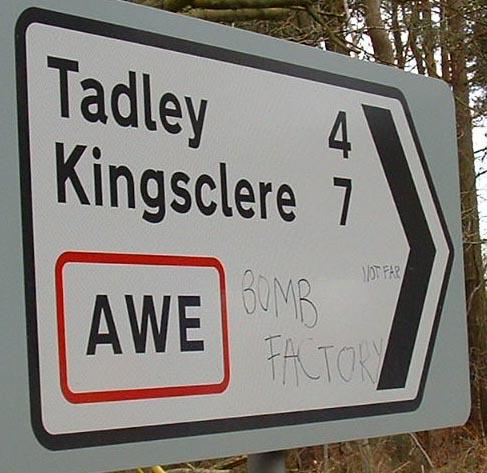
An accident involving Trident nuclear warheads being moved on Britain’s roads could lead to a partial nuclear blast, an internal Ministry of Defence report admits.
The document, obtained by New Scientist magazine, says such an explosion could potentially deliver a lethal radiation dose to the surrounding area. The MoD describes the risk as significant enough for drawing up contingency plans to deal with such an event.
The warheads are regularly transported by road convoy between military facilities in the UK. The weapons are moved between submarine bases in Scotland and repair and maintenance facilities at the Berkshire sites of Aldermaston and Burghfield. One convoy round trip happens roughly every two to three months.
According to the report a large accident, for example a plane landing on a convoy, could trigger a partial detonation which would have “potentially high off-site consequences”. It says radiation doses from such a blast could range from one to 10 sieverts. Exposure to four sieverts would kill 50% of exposed people through acute radiation poisoning, while six sieverts would kill everyone exposed.
I wonder who thought up the focus on a “partial nuclear blast”? Does that leave you a little bit radioactive or only semi-dead?




In a plutonium warhead ( the only kind used in our missles) the confinment that creates the nuclear explosion comes from an extremely controlled focused spherical implosion. If the explosives surrounding the core don’t all explode at the exact time, the shock waveform doesn’t compress the core properly.
When this happens (thankfully such a thing hasn’t) the core should disintegrate into a cloud of extremely toxic and radioactive (yes, plutonium is both) particles. This is where the greatest danger lies.
Under very special and rare conditions, the core can compress just enough to initiate a reaction, but since it isn’t properly contained it peters out quickly. Such a “squib” explosion can be pretty dramatic, but would “only” have a yield of a few tons of TNT. This would be pretty terrible, but would almost never happen.
In reality, the munitions are in very sturdy canisters and would require a catastrophic impact to damage the weapon to the point where it would trigger, however improperly. Also, don’t forget the warhead isn’t just packaged, it itself is designed to handle shocks of several G’s. (It is designed to sit on the top of a missile, after all.)
Alix, you are very correct. The paranoid side of me is still a little nervous about that amount of firepower rolling down some highway. The “what if” scenario makes for a lot of fiction writing, but does expose a possibility. And the more often this happens, the greater the probability of a problem arising even if that probability has a dozen zeros after the decimal.
I thought we still did a lot of transportation by train, but I am way out of date:
http://www.cpeo.org/lists/military/1999/msg00094.html
Nuclear weapons are not transported on trains in the United States.
The last U.S. rail shipment of nuclear weapons occurred in 1985.
Was it really that long ago that the protestor fell [was pushed??] under the train heading to Bangor, WA??
Anyway, the short road from SWFPAC [Strategic Weapons Facility Pacific] to the EHW [Explosives Handling Wharf ] at Bangor passed under some electrical transmission lines – and there were large nets installed under those cables to prevent any possiblity that one of those lines could fall on a truck during transfer of weapons.
Of course, Navy policy is to neither confirm nor deny the presence of weapons at a particular facility, or onboard a particular vessel. They were just ready in case any weapons needed to be transported along that road. [grin]
http://www.globalsecurity.org/wmd/facility/bangor.htm
Chances of an actual accident are calculated at 2.4 in a billion. Wow.. big reason to lose sleep at night.
Their scenario: if an airplane were to hit a weapon, and there were to magically be multiple failures of the many interlocks, then sometjing could happen. Even in that unlikely scenaro, the most likely outcome would be a ‘fizzle’, which is a partial detonation.
The reality is that most of these weapons are transported with critical detonation parts removed and detonation spoilers in place, sodetonation is highly unlikely even in the worst case scenario. You ave to try really hard to get a nuclear explosion to take place, with timing eroros in the microseconds being enough to spoil the explosion.
The complexity of accidentally exploding a nuclear warhead is obviously beyond the understanding of both Britain’s Defense Department and the readership of this blog.
I’m not going to go into the details since Osama Bin Laden has been an avid Dvorak reader since John edited InfoWorld.
However having been involved in the actual hands on arming of nuclear warheads, I can assure you that a nuclear accident, expecially on a roadway which has extremely low impact speeds compared to an air drop, is miniscule. The warheads are too hardened and the sequence of events to explode them cannot occur through any type of accidental impact.
For those interested you can get more (unclassified) info about nuclear weapons here:
http://www.nuclearweaponarchive.org
What’s more likely is that a warhead gets nicked in transit… now that is worrying (queue “24” theme tune…)
They’re utter morons. You could say an asteroid strike on the convoy would cause them to “partially explode” as well. Of course, the direct effects of the plan crash/asteroid strike would outweigh that, but who’s counting…
The Blair goverment wants more nuke power……so why they worried?
“Trust me, I know” is hardly a convincing argument in any thread.