
NUKU’ALOFA, Tonga — If the giant earthquake Thursday in the South Pacific had spawned a deadly tsunami, many islanders would not have learned about it until a wall of water bore down on them.
Nearly 18 months after a tsunami in the Indian Ocean left at least 216,000 people dead or missing, sparking international calls for a better warning system, Pacific islanders got little or no notice of the latest possible tsunami.
When I saw the headline, I figured, “Cripes, they’re still not up to speed on protocols, communications, etc.”. Then I read the details. They used radio, telegrams, faxes, emails — everything you would think could be used.
The Pacific Tsunami Warning Center says its first alert went out 16 minutes after the magnitude 7.9 earthquake occurred about 150 kilometers, or 90 miles, south of Neiafu, Tonga, and 2,160 kilometers north-northeast of Auckland. The quake struck at 4:26 a.m. in Tonga.
But the alert was not received in Tonga, closest to the epicenter, said the center’s acting director, Gerard Fryer.
“There was a problem in Tonga where there was a power outage and they didn’t get our initial message,” he said, adding that the center needs to work with Tonga to correct the problem. He said he did not know whether the power failure was caused by the earthquake.
Communications systems pretty much require electricity — unless you want to try building the biggest flare gun in the world. Yes, there also were a few small islands that didn’t count on being warned either — because they haven’t electricity and don’t all utilize battery-powered radios to listen 24/7 to meteorology reports. Sounds like back-up generators should be installed, here and there.
The warning system worked. What didn’t work, what wasn’t working, was the infrastructure in Tonga. An important question; but, not what the headline addresses.




I like the giant flare gun idea. It might be a good use for ICBMs that are being pulled out of service.
They could install some portable generators for the radios. If they don’t have enough local populace ot man the radios they could make a deal with tourists to man the radios. Discount on hotel etc. and man the radio for 12 hours. They probably have great scuba diving.
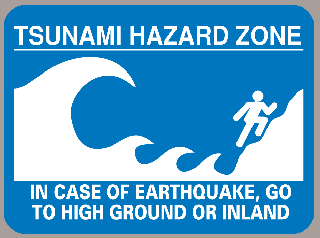
Uhhh, why not just educate people to the signs of a coming Tsunami? It’s pretty obvious….the water receeds, farther than normal during an extreme low tide….then rushes back. There is often enough of a delay to get to higher ground….it’s not brain surgery, you know. IT’s knowledge! Why not warning signs explaining more than that stupid little running man sign in the native language, and several major “tourist” ones?
The warning systems are out-dated, but that’s because there has been no real concerted effort to update the system. Faxes and telegraphs work, if there is a system in place….but the problem is…..the time BETWEEN tsunami’s (and earthquakes) in general is too far for people to remember.
Isn’t this part of the new warning system that is just being set up? Thats not completely online yet.
But, the MSM dosen’t care what the reasons were, they just wanted the headline.