
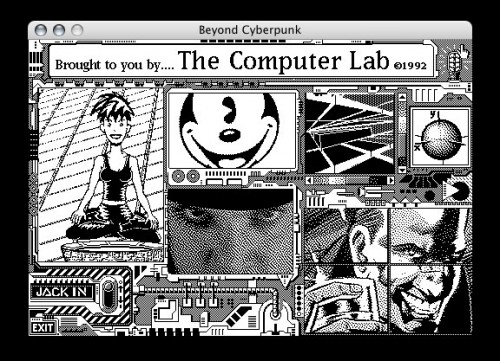
HyperCard allowed you to create “stacks” of cards, which were visual pages on a Macintosh screen. You could insert “fields” into these cards that showed text, tables, or even images. You could install “buttons” that linked individual cards within the stack to each other and that played various sounds as the user clicked them, mostly notably a “boing” clip that to this day I can’t get out of my mind. You could also turn your own pictures into buttons.
Not only that, but HyperCard included a scripting language called “Hyper Talk” that a non-programmer like myself could easily learn. It allowed developers to insert commands like “go to” or “play sound” or “dissolve” into the components of a HyperCard array.
[…]
Even before its cancellation, HyperCard’s inventor saw the end coming. In an angst-filled 2002 interview, Bill Atkinson confessed to his Big Mistake. If only he had figured out that stacks could be linked through cyberspace, and not just installed on a particular desktop, things would have been different.
“I missed the mark with HyperCard,” Atkinson lamented. “I grew up in a box-centric culture at Apple. If I’d grown up in a network-centric culture, like Sun, HyperCard might have been the first Web browser. My blind spot at Apple prevented me from making HyperCard the first Web browser.”




 Called the