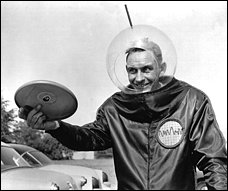
Fred Morrison, 90, a pilot and carpenter most often credited with inventing that most ubiquitous of backyard toys, the Frisbee, died Feb. 9 at his home in Monroe, Utah. He had lung cancer.
People have been tossing flat, round objects for millennia, and the origins of the Frisbee have been shrouded in conflicting claims and legend. But it was Mr. Morrison who created the flying disc that was eventually marketed to the world, giving rise to a beloved form of egalitarian picnic entertainment and spin-off sports including Ultimate Frisbee, canine Frisbee, freestyle Frisbee and professional disc golf, a sport that’s grown large enough that its champions can now make a living on prize money and sponsorships.
Inspiration for Mr. Morrison’s flying-saucer toy came in 1937 at a Thanksgiving feast in Southern California. He and his girlfriend, Lucile “Lu” Nay, entertained themselves by tossing a popcorn-tin lid in the backyard. The lid eventually became dented, ruining its aerodynamic potential, and the resourceful couple snatched a cake pan from Mr. Morrison’s mother’s kitchen.
Cake pans, it turned out, were sturdier and flew better — so much so that one day, when the two were flinging a pan back and forth on the beach, an impressed passerby offered to buy it. The pan had originally cost a nickel, the stranger offered a quarter — and that exchange was enough to whet Mr. Morrison’s entrepreneurial appetite.
“That got the wheels turning,” he told a Norfolk, Va., reporter in 2007. “There was a business.”
RIP Fred… my dogs and I thank you for many years of entertainment.


 Roger Smith, chief technology officer for PEO STRI, the Army command responsible for purchasing training equipment, claims that Microsoft refused to sell him the consoles. Smith told me that he discussed acquiring the Xbox with Microsoft representatives at a trade show back in 2006. According to Smith, the Microsoft executives said they would neither sell the Xbox 360 nor license XNA game development tools to the Army for three reasons:
 * Microsoft was afraid that the military would buy up lots of Xbox 360s, but would buy only one game for each of them, so MS wouldn’t make much money off of the games.






 It may come as a surprise to most of the owners of the country’s 277 million cell phones but their cell phone company retains records of where their device has been at all times–either because the phones have tiny GPS devices embedded inside or because each phone call is routed through towers that can be used to pinpoint the phones’ location to within areas as small as a few hundred feet.