74 Comments

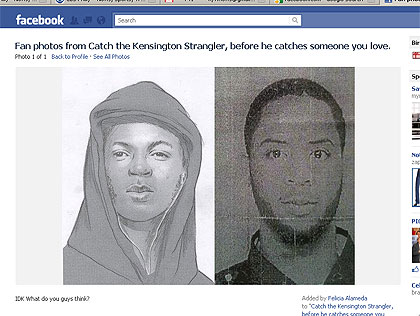
PHILADELPHIA (CBS) – Philadelphia police say someone posted false information on Facebook identifying a city man as the Kensington Strangler. Now, police want to get the word out to protect the man from vigilante justice.
Police Lieutenant Ray Evers says police found out about the Facebook posting mid-Monday morning. The fan page had a photo of a man and his address. “This fan page was saying this man was the Kensington Strangler. Looking at this picture, we notified Homicide and Special Victims and they said, no this male is not a subject in this investigation and is not wanted in this investigation.”
Evers says the man was at his mother’s home and people were gathering outside, so he called police to tell them it wasn’t him. The man was then escorted by 25th District Police to Special Victims where he was interviewed, and cleared, and then he was taken to Homicide. “We utilized our own Facebook page, and it was our duty to say that this male was not wanted, was not a subject of our investigation.”
Evers says Facebook is a social network; it is not a fact checking site, and this can be damaging to innocent people.
It’s only a matter of time. Welcome to New America.
Before there were full-body scanners, there were puffers. The Transportation Security Administration spent about $30 million on devices that puffed air on travelers to “sniff” them out for explosives residue. Those machines ended up in warehouses, removed from airports, abandoned as impractical.
The massive push to fix airport security in the United States after the attacks of Sept. 11, 2001, led to a gold rush in technology contracts for an industry that mushroomed almost overnight. Since it was founded in 2001, the TSA has spent roughly $14 billion in more than 20,900 transactions with dozens of contractors.
In addition to beefing up the fleets of X-ray machines and traditional security systems at airports nationwide, about $8 billion also paid for ambitious new technologies. The agency has spent about $800 million on devices to screen bags and passenger items, including shoes, bottled liquids, casts and prostheses. For next year, it wants more than $1.3 billion for airport screening technologies.
But lawmakers, auditors and national security experts question whether the government is too quick to embrace technology as a solution for basic security problems and whether the TSA has been too eager to write checks for unproven products.
Time for a collective ‘Duh!”

While the video is a promo for a shopping center, you see their rather large Caganer leaving his traditional Christmas “present” as he’s being assembled.

A rare drama will play out in tonight’s skies: a full lunar eclipse on the winter solstice.
The last one occurred in 1638, according to NASA, and tonight’s may be only the second one in the last two millennia.
“Since Year 1, I can only find one previous instance of an eclipse matching the same calendar date as the solstice, and that is 1638,” Geoff Chester of the U.S. Naval Observatory, who inspected a list of eclipses going back 2,000 years, said on NASA’s solstice lunar eclipse page. The next lunar eclipse on the winter solstice won’t be such a long wait, though. It’s expected in 2094.
Skywatchers expect the eclipse to occur over a three-and-a-half hour period, starting at 10:33 p.m. PT today and ending 2:01 a.m. PT tomorrow. The Earth’s shadow will completely cover the moon for about 72 minutes, according to NASA’s eclipse page. The shadow is likely to have a reddish hue.
|
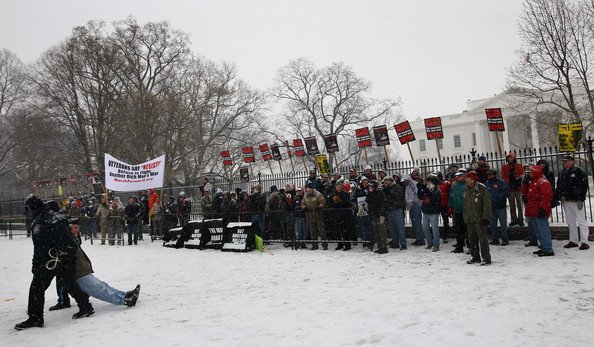
There was a black-out and a white-out Thursday and Friday as over a hundred US veterans opposed to US wars in Afghanistan and elsewhere around the world, and their civilian supporters, chained and tied themselves to the White House fence during an early snowstorm to say enough is enough.
Washington Police arrested 135 of the protesters, in what is being called the largest mass detention in recent years. Among those arrested were Ray McGovern, a former CIA analyst who used to provide the president’s daily briefings, Daniel Ellsberg, who released the government’s Pentagon Papers during the Nixon administration, and Chris Hedges, former war correspondent for the New York Times.
No major US news media reported on the demonstration or the arrests. It was blacked out of the New York Times, blacked out of the Philadelphia Inquirer, blacked out in the Los Angeles Times, blacked out of the Wall Street Journal, and even blacked out of the capital’s local daily, the Washington Post, which apparently didn’t even think it was a local story worth publishing an article about (they simply ran a photo of Ellsberg with a short caption).
Found by Cinàedh.

When people who did not celebrate Christmas or who did not identify themselves as Christian filled out surveys about their moods while in the same room as a small Christmas tree, they reported less self-assurance and fewer positive feelings than if they hadn’t been reminded of the holiday, according to a new study.
The university students didn’t know the study was about Christmas, said study researcher Michael Schmitt, a social psychologist at Simon Fraser University in British Columbia, Canada. Nonetheless, he said, the presence of the tree caused non-celebrators and non-Christians to feel subtly excluded.
Who says there is no war on Christmas? Apparently there is a war on decorations and symbols. Displaying one might not make someone feel included. Tell the NFL to stop selling jerseys too. This is ridiculous.

Here’s one view:
[This] morning the Federal Communications Commission (FCC) will mark the winter solstice by taking an unprecedented step to expand government’s reach into the Internet by attempting to regulate its inner workings. In doing so, the agency will circumvent Congress and disregard a recent court ruling.
[…]
For years, proponents of so-called “net neutrality” have been calling for strong regulation of broadband “on-ramps” to the Internet, like those provided by your local cable or phone companies. Rules are needed, the argument goes, to ensure that the Internet remains open and free, and to discourage broadband providers from thwarting consumer demand. That sounds good if you say it fast. […] Nothing is broken that needs fixing, however. […] Ample laws to protect consumers already exist.
[…]
On this winter solstice, we will witness jaw-dropping interventionist chutzpah as the FCC bypasses branches of our government in the dogged pursuit of needless and harmful regulation. The darkest day of the year may end up marking the beginning of a long winter’s night for Internet freedom.
And here’s another:
I simply do not understand how net neutrality detractors think that the proposed rules the FCC wants to put into place could hurt innovation. Even a cursory read of the rules shows that they are trying to set a level playing field ensuring that those who control the last mile cannot arbitrarily limit or restrict access to Internet services. Open access does not stifle innovation. Open access to Internet services is the catalyst to innovation. Let’s face it, telco’s and cable companies are the least innovative companies around. They only innovate to protect their turf.

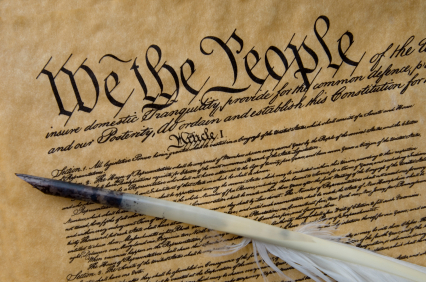
But with the Congress made up of people elected from the states, doesn’t that mean the states (ie, the states’ electorate) are effectively in control anyway? Or is this just an attempt at an end around specific legislation by Congress the supporters don’t like?
The same people driving the lawsuits that seek to dismantle the Obama administration’s health care overhaul have set their sights on an even bigger target: a constitutional amendment that would allow a vote of the states to overturn any act of Congress.
Under the proposed “repeal amendment,” any federal law or regulation could be repealed if the legislatures of two-thirds of the states voted to do so.
The idea has been propelled by the wave of Republican victories in the midterm elections. First promoted by Virginia lawmakers and Tea Party groups, it has the support of legislative leaders in 12 states. It also won the backing of the incoming House majority leader, Representative Eric Cantor, when it was introduced this month in Congress.
Like any constitutional amendment, it faces enormous hurdles: it must be approved by both chambers of Congress — requiring them to agree, in this case, to check their own power — and then by three-quarters of, or 38, state legislatures.
[…]
The repeal amendment reflects a larger, growing debate about federal power at a time when the public’s approval of Congress is at a historic low. In the last several years, many states have passed so-called sovereignty resolutions, largely symbolic, aimed at nullifying federal laws they do not agree with, mostly on health care or gun control.
This Episode’s Executive Producer: Geoff Crowther
Associate Executive Producers: Ann Nonymous
Art By: Nick the Rat
Sign up for No Agenda Show Talking Points signup here.
No Agenda Survey Results
Listen to show by clicking ►
Direct link to show.
Show Notes here.
Show forum here.
Sign up for No Agenda Talking Points Newsletter signup here.

Mark Moody said he was taking his usual nicotine break on the window ledge of his Peck Slip home on a hot August day with a cigarette in one hand and a cellphone in the other, a scant 12 feet off the ground. He was shocked when a police car rolled up and two cops jumped out.
“Are you about to commit suicide?” one cop asked.
“If I was going to commit suicide, this would be a pretty dumb place to do it,” the 40-year-old trial lawyer scoffed. “If I jumped from here, I’d just sprain my ankle.”
[…]
Before he knew it, a beefy officer was inside his apartment, lifting him out of his own living-room window from behind, Moody said. The cop slammed him on the living-room floor while another kneeled on top of him and cuffed him, he claimed. […] The attorney was thrown into an ambulance and taken to Beth Israel Medical Center.The on-duty psychiatrist apologized before quickly discharging him, Moody said. “I talked to him for three minutes, and he said, ‘Look, I’m really sorry. I apologize on behalf of the city,’ ” Moody recalled.
[…]
Moody, who The Post found still takes his cigarette breaks sitting in his open window, sued the city and the police officers for $400,000 in damages on Dec. 8 in Manhattan federal court.

Documents seen by the Guardian reveal for the first time the full details of the allegations of rape and sexual assault that have led to extradition hearings against the WikiLeaks founder, Julian Assange.
[…]
Assange, who was released on bail on Thursday, denies the Swedish allegations and has not formally been charged with any offence. The two Swedish women behind the charges have been accused by his supporters of making malicious complaints or being “honeytraps” in a wider conspiracy to discredit him.Assange’s UK lawyer, Mark Stephens, attributed the allegations to “dark forces”, saying: “The honeytrap has been sprung … After what we’ve seen so far you can reasonably conclude this is part of a greater plan.” The journalist John Pilger dismissed the case as a “political stunt” and in an interview with ABC news, Assange said Swedish prosecutors were withholding evidence which suggested he had been “set up.”
However, unredacted statements held by prosecutors in Stockholm, along with interviews with some of the central characters, shed fresh light on the hotly disputed sequence of events that has become the centre of a global storm.
Read the article to find out what the charges are.
 For Kindle and with free ePub version. Only $9.49 Great reading.
Here is what Gary Shapiro CEO of the Consumer Electronics Association (CEA) said: Dvorak's writing sings with insight and clarity. Whether or not you agree with John's views, he will get you thinking and is never boring. These essays are worth the read!
For Kindle and with free ePub version. Only $9.49 Great reading.
Here is what Gary Shapiro CEO of the Consumer Electronics Association (CEA) said: Dvorak's writing sings with insight and clarity. Whether or not you agree with John's views, he will get you thinking and is never boring. These essays are worth the read!

Subscribe to Main Blog feed here:


Subscribe to Comments too (below):

Bad Behavior has blocked 10362 access attempts in the last 7 days.