This Episode’s Executive Producer: Sir Sam Leung
Associate Executive Producer: Troy Rutter
Art By: Nick the Rat

Sign up for No Agenda Show Talking Points signup here.

Donate to show here or here.

No Agenda Survey Results

Listen to show by clicking ►

Direct link to show.
Show Notes here.
Show forum here.

Sign up for No Agenda Talking Points Newsletter signup here.


gizmag

The Seoul Metropolitan Government (SMG) has claimed a world first by deploying electric buses on a commercial route. Previous electric bus operations have all been trials, or in the case of Expo 2010 in Shanghai, free public services. The buses went into service on December 21 after an 18 month development project with Hyundai Heavy Industries and Hankuk Fiber.

The electric coaches serving on the Mt. Namsan circular routes are 11.05 meters long and run up to 83km with a single charge. The lithium-ion battery pack can be fully charged in less than 30 minutes and the bus has a maximum speed of 100 km/h. There’s also a regenerative system that reuses energy from brakes when running downhill.


Gawker

The fearsome news Voltron that is the Daily News Beastweek has compiled a list of the 40 Drunkest Cities in the US, using the average number of drinks consumed per person in a month. So how did your city fare?

Well, the results are somewhat surprising! Here are the top ten:

  • 1. Milwaukee, WI
  • 2. Fargo, ND
  • 3. San Francisco, CA
  • 4. Austin, TX
  • 5. Reno, NV
  • 6. Burlington, VT
  • 7. Omaha, NE
  • 8. Boston, MA
  • 9. Anchorage, AK
  • 10. San Diego, CA

So most of those make sense. Boston, obviously. The Midwest, clearly. But San Francisco? That seems odd. I guess you have to factor in all the fancy wine and fruity cocktails consumed at summer garden parties. (Everyone in San Francisco is gay, you see). Otherwise America’s gay lagoon doesn’t strike me as a very drinky-drinky city.

Click here to see the complete list.

Found by Cinàedh.


A powerful bankers’ association has failed in its attempt to censor a student thesis after complaining that it revealed a loophole in bank card security.

The UK Cards Association, which represents major UK banks and building societies, asked Cambridge University to remove the thesis from its website, but the request was met with a blunt refusal…

The thesis by computer security student Omar Choudary, entitled “The smart card detective: a handheld EMV interceptor”, described a flaw in the chip-and-pin (personal identification number) security system that allows criminals to make fraudulent transactions with a stolen bank card using any pin they care to choose…

But in a reply to the UKCA, Ross Anderson, professor of security engineering at the university’s Computer Laboratory, refused to take down the thesis and said the loopholes had already been disclosed to bankers.

You seem to think we might censor a student’s thesis, which is lawful and already in the public domain, simply because a powerful interest finds it inconvenient. This shows a deep misconception of what universities are and how we work. Cambridge is the University of Erasmus, of Newton and of Darwin; censoring writings that offend the powerful is offensive to our deepest values,” Anderson wrote.

Right on, Professor Anderson!


Before there was WikiLeaks, there was Cryptome. (And it’s probably a safe bet that after WikiLeaks is long gone, there will still be a Cryptome.) Via Spencer Ackerman at Wired’s Danger Room, here’s a pair of memos, posted to the intelligence-secrets website, that show the CIA was all up in that Inception-type business in the Cold War: using deep hypnosis to create unwitting double agents and implant secret communications in their brains, where they can’t be intercepted! Cue evil laugh! “I assure you, it will work,” the agency’s mesmerism cheerleader writes. Full docs are here.

No surprises here to those who are well-acquainted both with science fiction and the CIA’s fondness for far-out mind experiments. Ackerman reminds us about Project MKULTRA and the crazy acid tests that comprised America’s war on commies until the ’70s, when Congress’ Church Commission put the kibosh on all that cloak-and-doctor intrigue. Even so, these two docs, dated from 1954 and 1955, are worth a good read. And they remind us that digital leak sites can do more than publicize the lifestyles of the Kazakhstani leadership.

That was the ’50s. Imagine what they’re able to do now. Or not. If these tactics really worked well to get people to do what you want, why would we need waterboarding, etc. to torture confessions and info from the Gitmotized?


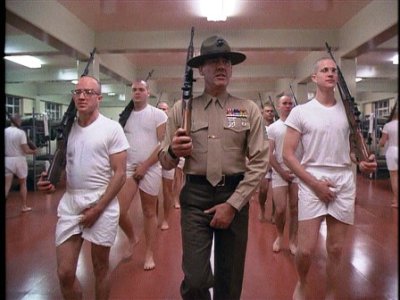
“Were you born a fat, slimy, scumbag puke piece o’ shit, Private Pyle,
or did you have to work on it?”

During the past decade, the U.S. Army has faced what it regards as a serious internal threat: young recruits entering in terrible shape.

In a radical shift, the Army is overhauling the way it trains, cares for and feeds new soldiers. So, as fad workouts increasingly borrow Army terms like “boot camp,” actual basic training is starting to look a bit like a new-age fitness camp — but with harsh words, severe haircuts and firearms. […] Many of the freezing future soldiers, in gray sweats, caps and gloves, are struggling to do a few pull-ups.

A decade ago, the Army started to notice that new recruits were, in general, getting weaker. […] The Army’s problem, Stone and others say, is that most current enlistees grew up on the couch, playing video games, rather than horsing around outside. And public schools have cut gym classes.
[…]
Palkoska has completely revamped basic training at all posts, starting with, well, the basics: stretching and holding; mastering simple, precise movements. Soon, athletic trainers and physical therapists will join these workouts at Fort Leonard Wood to help soldiers avoid injuries and to quickly treat those that occur.

“I saw a lot of folks saying that we had gone to yoga and Pilates,” says Mark Hertling, the three-star general in charge of initial military training for the entire Army. “And I’m saying, ‘Where the hell did they get that?’ It’s all about functional fitness, and using the body the way it might have to be used in a tactical situation.”


Daylife/Reuters Pictures used by permission

John Doerr, venture capitalist, and Facebook founder Mark Zuckerberg

A red-hot trading market has developed in the shares of the world’s leading social networking companies: Facebook, Twitter, Zynga and LinkedIn. What is unusual is that none of the companies are listed on a public stock exchange. Each is privately held.

Now, the Securities and Exchange Commission wants to learn more about the business of these stock trades. The agency has sent information requests to several participants in the buying and selling of stock in these four companies, according to two people with direct knowledge of the inquiry who requested anonymity because they were not authorized to speak about it.

It is unclear exactly what has piqued the agency’s interest. An S.E.C. spokesman declined to comment on the matter. But the S.E.C.’s interest comes as a crop of new exchanges is popping up to facilitate these trades…

Who is selling these shares? Much of the supply comes from former employees at these companies and their early stage venture capital investors looking to exit their stakes.

The buyers in these so-called secondary trading markets are mostly wealthy speculators looking to snag a piece of the next Apple, Microsoft or Google before the rest of the investing public can

It is uncertain what exactly the S.E.C. is looking into, but several securities lawyers say it could relate to understanding the number of shareholders at these companies.

That would be relevant to regulators because Facebook and other start-ups have a reason to keep the number of shareholders to under 499. If they had 500 shareholders, S.E.C. rules would require them to disclose their financial results to the public…

The only surprise is that the SEC is actually getting off their rusty dusty and doing some investigating. Not that it guarantees any response if they discovered illicit activities.


The worst part is how the host treats the two guests (one, a journalist who’s saying facts; the other, a government official).


The science is in!

The high topography of Asia influences the atmosphere in profound ways. The jet stream, a river of fast-flowing air five to seven miles above sea level, bends around Asia’s mountains in a wavelike pattern, much as water in a stream flows around a rock or boulder. The energy from these atmospheric waves, like the energy from a sound wave, propagates both horizontally and vertically.

As global temperatures have warmed and as Arctic sea ice has melted over the past two and a half decades, more moisture has become available to fall as snow over the continents. So the snow cover across Siberia in the fall has steadily increased.

The sun’s energy reflects off the bright white snow and escapes back out to space. As a result, the temperature cools. When snow cover is more abundant in Siberia, it creates an unusually large dome of cold air next to the mountains, and this amplifies the standing waves in the atmosphere, just as a bigger rock in a stream increases the size of the waves of water flowing by.

The increased wave energy in the air spreads both horizontally, around the Northern Hemisphere, and vertically, up into the stratosphere and down toward the earth’s surface. In response, the jet stream, instead of flowing predominantly west to east as usual, meanders more north and south. In winter, this change in flow sends warm air north from the subtropical oceans into Alaska and Greenland, but it also pushes cold air south from the Arctic on the east side of the Rockies. Meanwhile, across Eurasia, cold air from Siberia spills south into East Asia and even southwestward into Europe.

That is why the Eastern United States, Northern Europe and East Asia have experienced extraordinarily snowy and cold winters since the turn of this century.

I guess that takes care of that. We’re dooooooomed! Might as well party!


38 seconds represent about 20 hours. Direct link to the video here: http://vimeo.com/18213768


Undoubtedly, the Thread and Bobbin Sewing Kit that Aunt Mildred sent from Amazon.com for Christmas will never see a stitch. The Stallion Stable Music Box might have looked pretty on the computer screen, but under the tree’s flickering lights, it is frightful. The polka-dot nightgown has never been a good idea, even with free shipping.

These gifts sent via some warehouse many miles away are not only unwanted, but also a multimillion-dollar headache: They have to be repacked, labeled, dropped off and shipped back to Amazon’s Island of Misfit Toys. Then a new present has to be packed, labeled and shipped again. Efficient, the process is not.

Amazon is working on a solution that could revolutionize digital gift buying. The online retailer has quietly patented a way for people to return gifts before they receive them, and the patent documents even mention poor Aunt Mildred. Amazon’s innovation, not ready for this Christmas season, includes an option to “Convert all gifts from Aunt Mildred,” the patent says. “For example, the user may specify such a rule because the user believes that this potential sender has different tastes than the user.” In other words, the consumer could keep an online list of lousy gift-givers whose choices would be vetted before anything ships.

Amazon’s proposal has raised the ire of the Miss Manners crowd, which thinks the scheme rather uncouth. After all, receiving an e-mail notification of a forthcoming gift – and thereby being able to check its price – is hardly the same as unwrapping the item at home…

Amazon appears to be quite serious: Its patent was awarded not just to Amazon, but to its founder, Jeff Bezos…Amazon’s patent is 12 pages long, with numerous diagrams, including a “Gift Conversion Rules Wizard” that shows how a user could select rules such as, “No clothes with wool.” The document makes for curious reading, reducing the art of gift giving to the dry language of patentry…

RTFA. The patent description is about as dry – and humorous – as you might expect. It lays down a line between propriety and opportunity that will kick off some delightful family arguments.



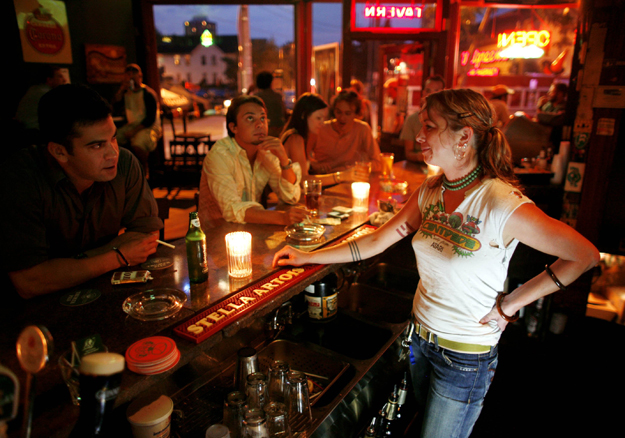
Found by What?


Click pic for more manly accentuating 70’s fashion


« Previous PageNext Page »

Bad Behavior has blocked 11848 access attempts in the last 7 days.