Wait for the guy in the red shirt

Artificial intelligence researchers often idealize Isaac Asimov’s Three Laws of Robotics as the signpost for robot-human interaction. But some robotics experts say that the concept could use a practical makeover to recognize the current limitations of robots.

Self-aware robots that inhabit Asimov’s stories and others such as “2001: A Space Odyssey” and “Battlestar Galactica” remain in the distant future. Today’s robots still lack any sort of real autonomy to make their own decisions or adapt intelligently to new environments.

But danger can arise when humans push robots beyond their current limits of decision-making, experts warn. That can lead to mistakes and even tragedies involving robots on factory floors and in military operations, when humans forget that all legal and ethical responsibility still rests on the shoulders of homo sapiens.

“The fascination with robots has led some people to try retreating from responsibility for difficult decisions, with potentially bad consequences,” said David Woods, a systems engineer at Ohio State University.

Woods and a fellow researcher proposed revising the Three Laws to emphasize human responsibility over robots. They also suggested that Earth-bound robot handlers could take a hint from NASA when it comes to robot-human interaction.

Read the article to see how they want to change them.


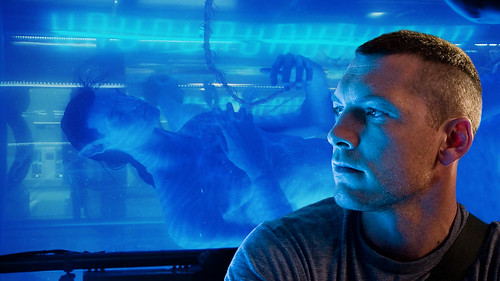
Yesterday I had the opportunity to watch 15 minutes Avatar as part of a worldwide event to promote the movie. In this case I saw the footage at the Wimbledon Imax (fake Imax for some since it doesn’t have the actual large IMAX screen). The preview opens with a message from the director, James Cameron, giving just a brief description to set up the story, placed in the 22nd century, indicating that the protagonist (see photo above) visits a world called Pandora (which I think was called Gaia in the original script). This is a full 3D movie and it looks spectacular, but no matter how good it is, you can still tell the difference between live action and CGI. The trailer below gives some indication of the look of the movie, but does not actually do justice about how good it is.
There really is no explanation about the plot of the movie, no indication about the reasons for humans being on the planet Pandora, so the footage was light on plot but rich in action.
Any other of our readers had the opportunity to watch the footage?


Remember the book and film that coined the phrase, Catch-22? That phrase revolved around if you stated flying too many missions had made you crazy and you should be grounded, that meant you knew what you were doing, weren’t crazy and had to fly more missions.

Do these new tests have a built-in Catch-22 that if you prove you’re a killing machine that means you can’t join and become a killing machine?

The Army is set to introduce a new mental-health test of unprecedented size and scope as part of its increasing efforts to improve soldiers’ mental wellness amid the strain of repeated deployments.

Come October, the service will require all its active duty, National Guard, and reserve soldiers to take a test that will help identify potential problem areas for soldiers. The 170-question test will look at physical, mental, emotional, spiritual, and family issues and then recommend follow-on training as needed.

The program comes as the Army is tackling rising suicide rates, divorce, and depression among thousands of soldiers returning from war. But unlike other programs, which seek to intervene when a soldier’s issues have already been flagged by other screening methods, this program aims to be more proactive.
[…]
For an institution that molds warriors, the program will test the ability of the rank and file to move beyond the natural stigma of talking about feelings. James Quick, a fellow at the American Psychological Association and a retired Air Force colonel, says such a program aims for more thorough wellness.


Tracy Clark-Flory – Salon – Aug. 18, 2009:

Teenagers now have access to a free Internet library of “bestiality, piss-drinking, throat-fucking, bukkake gang bangs, triple anal penetrations” (and let’s not forget, coprophilia), as Eric Spitznagel puts it in the September issue of Details. There’s no doubt this is influencing teen sexuality — I mean triple anal penetrations on demand, c’mon! — but he sets out to answer the question of how it’s changing, exactly. That question truly deserves a book-length response, but his short answer is: Kids these days are having sex like porn stars.

The most vivid example he gives is that most members of Generation XXX think “sex ends with a money shot to the face.” Some boys, like one 17-year-old quoted in the piece, believe that “there is just something about blowing a load in a chick’s face that makes you feel like a man.” Spitznagel explains, “For most men over 30, facials aren’t something you actually do. They’re like car chases or hurling someone through a plate-glass window — the difference between cinema and life.

He gives other examples of how the sex lives of “America’s porn-fed youth” are different from past generations: They think pubic hair is nasty and anal sex is hot, and girls idolize the porn stars who inadvertently teach them how to give toe-curling blow jobs. But he spills the most ink, ehem, on the come on the face thing.


Find more milk facials here.


In the late 1980s, he founded McAfee Associates, the antivirus software company. The company went public in 1992, and two years later, he sold his remaining stake, bringing his gains to about $100 million.

[He was living a great life.] But then things began to change. In 2007, Mr. McAfee sold a 10,000-square-foot home in Colorado with a view of Pike’s Peak. He had spent $25 million to buy the property and build the house. He received $5.7 million for it. When Lehman collapsed last fall, its bonds became virtually worthless. Mr. McAfee’s stock investments cost him millions more.

His remaining net worth of about $4 million makes him vastly wealthier than most Americans, of course. But he has nonetheless found himself needing cash and desperately trying to reduce his monthly expenses.

Isn’t it strange the New York Times makes it sound like he’s so good and the “system” hurt him? He had a great company, got really rich, then made bad investments, got less rich. Simple.


Mexico decriminalized small amounts of marijuana, cocaine and heroin on Friday—a move that prosecutors say makes sense even in the midst of the government’s grueling battle against drug traffickers.

Prosecutors said the new law sets clear limits that keep Mexico’s corruption-prone police from extorting casual users and offers addicts free treatment to keep growing domestic drug use in check.

Will the US be next? I hope so. Drugs are bad, but like alcohol and cigarettes, they shouldn’t be regulated by the government.


WEST PALM BEACH, FL — There’s something lurking just under the surface of the Lake Worth Lagoon. Greg Reynolds of LagoonKeepers.org recalls, “Channel marker ten is the first time we saw the unknown creature.” “I hollered out…and said what is that? We followed it, started taking video.” This mysterious creature was caught on tape by the LagoonKeepers.

Don Serrano was with Reynolds. “I didn’t know what it was….I was like HEY LOOK! And we moved over and saw it. It was different, very different.” “Little wakes and just kind of moving like this…real long ones too, just like that.” Reynolds remembers, “We sped up on it to catch up to it and we got up on it, it dove down.” “Every time we get 10 feet from it, it would just disappear.”

What could it be?

“Who knows? I have no idea, but it was something that’s for sure, without a doubt,” said Serrano. Thanks to the LagoonKeepers, until it’s identified, it has a name: Reynolds calls it, “The elusive muck monster!” Thomas Reinert a Florida Fish and Wildlife Conservation Commission Marine Biologist studied the video and said: “This appears to be one animal moving in this direction…nothing’s breaking the surface. Typically dolphins break the surface, sea turtles, manatee, a large school of fish, if it were a shark at that level you would see a fin.”

“I cant definitely say what it is.” “I can speculate but we need more evidence to determine the identity of the Lake Worth muck monster,” said Reinert.

It’s just a Russian sub… no worries.


fail-owned-sculpture-fail

Click to see bigger picture.


Congress doesn’t want to join its own plan.

Rep. Dean Heller, R-Nev., told colleagues Thursday that members of Congress should be required to join any federal public health benefits plan created by Congress.

“I do not believe the federal government should be running health care in our country and levying massive tax increases on America’s small businesses,” said Heller in urging support for an amendment to the proposed plan. “However, if this administration and the majority party are going to force government-run health care on the American people, then members of Congress should be required to enroll in that plan. “If the government-run ‘public plan’ is good enough for millions of our constituents, then it should be good enough for members of Congress,” he said.

He asked the committee reviewing the America’s Affordable Health Choices Act to adopt the amendment requiring Congress to participate in the plan. The amendment, however, was rejected by the committee 21-18.


I don’t like the bill, but it’s not because of this death panel BS.


Received this by email just now. I really like Moore’s movies, even when I don’t agree with him.


http://www.aberdeendesignconcepts.co.uk/domain_name.jpg

There’s a war brewing at ICANN over who gets control over domain names. It’s a war between corporations and noncommercial groups. The Noncommercial User Constituency (NCUC) is trying to refute ICANN myths.

This excellent WSJ editorial uses Apple’s rejection of Google Voice for the iPhone at AT&T’s behest as the jumping off point on how screwed up our communications system and policy is in this country, and how to fix it.

Apple has an exclusive deal with AT&T in the U.S., stirring up rumors that AT&T was the one behind Apple rejecting Google Voice. How could AT&T not object? AT&T clings to the old business of charging for voice calls in minutes. It takes not much more than 10 kilobits per second of data to handle voice. In a world of megabit per-second connections, that’s nothing—hence Google’s proposal to offer voice calls for no cost and heap on features galore.

What this episode really uncovers is that AT&T is dying. AT&T is dragging down the rest of us by overcharging us for voice calls and stifling innovation in a mobile data market critical to the U.S. economy.
[…]
Some might say it is time to rethink our national communications policy. But even that’s obsolete. I’d start with a simple idea. There is no such thing as voice or text or music or TV shows or video. They are all just data.


A woman who woke up with one breast double the size of the other says pop star Pink was crucial to alerting her to the problem.

Kimberley Koy says she thought the experience was “very funny” – once she was told it was not breast cancer.

The cattle station worker’s ballooning boob shot out overnight after a plane trip to Sydney to see pop sensation Pink.

But the trouble, her doctor told her, had started a week earlier when a runaway cow had stabbed Ms Koy in the chest with its horn as she worked on a Cape York property.

And then things turned a little odd.


« Previous PageNext Page »

Bad Behavior has blocked 13716 access attempts in the last 7 days.