60 Comments
Best I’ve heard.
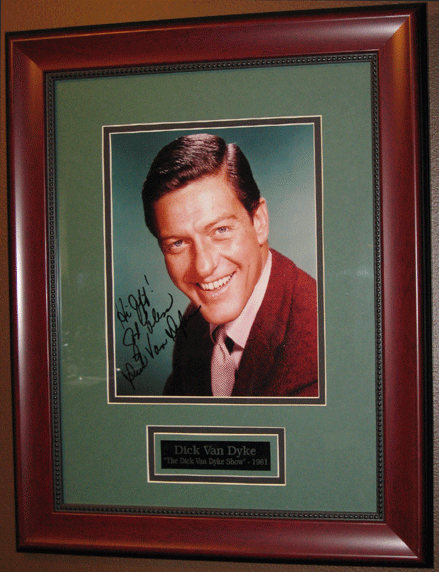
On screen, Dick Van Dyke has been rescued from untimely death by flying cars and magical nannies. Off screen, the veteran star of Chitty Chitty Bang Bang and Mary Poppins had to rely on the help of a pod of porpoises after apparently dozing off aboard his surfboard. “I’m not kidding,” he said afterwards.
Van Dyke’s ordeal began during an ill-fated trip to his local beach. “I woke up out of sight of land,” the 84-year-old actor told reporters. “I started paddling with the swells and I started seeing fins swimming around me and I thought ‘I’m dead!'”
Van Dyke was wrong. “They turned out to be porpoises,” he said. “And they pushed me all the way to shore.” The porpoises were unavailable for comment.
I hate to be a skeptic, but this story smells a little fishy. I mean, surfing at 84!!!
The best part is the retro way you store phone numbers in the phone. Well, perhaps ‘in’ is the wrong word. Check it out here.
This must have been hilarious to watch. And all the excuse making is too funny. Curiously none of the TSA folks did jack about the guy filming the episode with his phone cam. I guess the 3-year-old was more important.

Click pic to embiggen
At a former golf-shoe factory 13 miles from the Atlantic, workers at Shucks Maine Lobster drop up to 150 pounds of live lobsters into a perforated metal basket and sink them in the Avure 215L, a water-filled compression chamber affectionately known as the Big Mother Shucker. A pump pressurizes the water to 40,000 pounds per square inch—almost 2,700 times the pressure of the air around us, 60 times that of the deepest known lobster habitat, and more than twice the force at the bottom of the Pacific’s Mariana Trench.
At such extreme pressure, cellular activities cease, causing instant death, and the flesh disconnects from the exoskeleton. When the lobsters emerge six to eight minutes later, the succulent meat slips right out of the shell. The meat is then resubmerged in a bag, and the pressure is cranked up to 87,000 psi, destroying listeria and other food-borne bacteria. Because the force is uniform at all points, the flesh remains perfectly intact.

- Apple I to sell for $200,000?
- Apple to jigger with Java in some odd way to screw Android.
- Facebook going after GMail with Facebook mail. Cripes.
- Big fuss over Pedophile book. Whole story is odd and dumb. I discuss.
- Microsoft Kin back in play?
- Kinect system deconstructed.
- Want to see Phone 7, go to Radio Shack.
- Boxee box now out.
- Supercomputers will be inside sugar cube.
Right click here and select ‘Save Link As…’ to download the mp3 file.

gizmag
The recent Yemeni bomb threat has only highlighted the need for quick, accurate ways of detecting explosives. With their excellent sense of smell and the ability to discern individual scents, even when they’re combined or masked by other odors, this task is usually given to man’s best friend. But training these animals can be expensive and good sniffer dogs can be hard to find. Scientists have now developed an electronic sensor they say is more sensitive and more reliable at detecting explosives than any sniffer dog.
[…]
The device is made from an array of silicon nanowires, coated with a compound that binds to explosives to form a nanotransistor. To enhance the device’s sensitivity, the scientists developed each one with 200 individual sensors that work together to detect different kinds of explosives with what the scientists say is an unprecedented degree of reliability, efficiency and speed
Good… now maybe we can dump the x-ray scanners and intrusive pat-downs.
This Episode’s Executive Producer: Carrie Schön
Art By: Jesse Anderson
Sign up for No Agenda Show Newsletter signup here.
No Agenda Survey Results
Listen to show by clicking ►
Direct link to show.
Show Notes here.
Show forum here.
Sign up for No Agenda Show Newsletter signup here.

Here’s a Rubik robot from a couple of years ago.

GIZMODO
According to an official quoted in a Russian newspaper, the Kremlin has likely sent an assassin to kill Colonel Shcherbakov, the man who betrayed Anna Chapman and nine other spies living in the U.S. Wait, what year is this again?
An unnamed, high-ranking government official suggested to Moscow’s Kommersant paper that a “Mercader” had been sent after Shcherbakov, apparently referring to Ramón Mercader, the Spanish communist who assassinated Leon Trotsky in 1940. When asked about the Kommersant report, a spokesperson for Russia’s Foreign Intelligence Service said “We have no comment on this and will not have any.” C’mon, guys, you could at least say there wasn’t an assassin out looking for the guy.

cnet news
If you don’t want anyone to know about something you’ve done, then you shouldn’t do it.
Such words, first offered by Google CEO Eric Schmidt, might just occasionally be revolving around the Google compound this morning. Word has leaked out that the engineer who leaked a memo announcing that every Google employee would get a 10 percent pay raise has been fired.
According to CNN Money, Google took the draconian action and announced it to its staff. Visual evidence of this announcement is, as yet, strangely lacking.
While Google has declined to comment to several news outlets about this report, it might, to some, seem like an odd thing to do. It’s hardly likely that giving more than 23,000 people a raise could be kept secret. Normally, it’s hard for one person to keep their good news quite this confidential.
Hmmmm… good publicity then bad publicity.

On Wednesday November 10th, I had my first full day of living with the Chevrolet Volt. I would like to take you through it as if you were there.
First for those who asked, no I didn’t sleep in my Volt the night before, but when I awoke in the AM I was sure very excited and looking forward to going out to my garage and getting in it.
On my arrival there, I found the car had successfully fully charged while it was plugged in overnight. The display showed charging time was complete at 11:15 PM; I had plugged it in to the 240-v charger in the fully depleted state at 5:15PM…
When I booted up the car, that’s really what it is like turning it on though quicker, the battery showed I had 36 miles of EV range. That was determined based on previous driving behavior in a miles per kwh estimation. The car at that point had 133 mpg lifetime efficiency which was based on the more than 1200 engineering validation miles GM had put on it prior to my delivery.
The first leg of my journey was from my home to the first hospital I work at. The actual distance was 22.8 miles, and when I arrived, the car showed 15 miles of EV range were left. That drive took place mostly on the highway at 70 + MPH. Outside temperature was 49 degrees, and I kept the cabin at 72 degrees using ECO mode. Comfort mode setting indicated it would drain twice as much power if I had chosen it.
The car was a charm on the highway. It was more than fast enough to deal with all types of merges, entrances, and passes, and handled very sprightly. I looked to see if anyone stared or noticed the car, and interestingly I didn’t see one person do so.
RTFA and follow Dr. Lyle Dennis – as I have since he founded GM-Volt.com in January, 2007. He built the site – and fan base – based upon his well-reasoned preference for the electrification of automobiles. It’s been a long and always interesting journey.
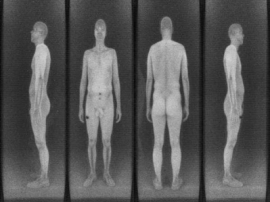
(Credit: John Wild (johnwild.info))
This image of an adult man was taken using a Rapiscan Secure 1000 backscatter X-ray scanner |
Two months ago, Homeland Security Secretary Janet Napolitano announced that the federal stimulus legislation would pay for the purchase of hundreds of controversial full-body scanners.
[…]
“We have received minimal complaints,” a TSA spokeswoman told CNET yesterday. She said that the agency, part of DHS, keeps track of air traveler complaints and has not seen a significant rise.A growing number of airline passengers, labor unions, and advocacy groups, however, say the new procedures–a choice of full-body scans or what the TSA delicately calls “enhanced patdowns”–go too far. (They were implemented without much fanfare in late October, amid lingering questions about whether travelers are always offered a choice of manual screening.)
Unions representing U.S. Airways pilots, American Airlines pilots, and some flight attendants are advising their members to skip the full-body scans, even if it means that their genitals are touched. Air travelers are speaking out online, with a woman saying in a YouTube video her breasts were “twisted,” and ExpressJet pilot Michael Roberts emerging as an instant hero after he rejected both the body scanning and “enhanced patdowns” options and was unceremoniously ejected from the security line from Memphis International Airport.
I would think that most people would not want to go through one of these scans. Plus, frequent flyers would build up a lot of radiation.
Support the Blog — Buy This Book!
 For Kindle and with free ePub version. Only $9.49 Great reading.
Here is what Gary Shapiro CEO of the Consumer Electronics Association (CEA) said: Dvorak's writing sings with insight and clarity. Whether or not you agree with John's views, he will get you thinking and is never boring. These essays are worth the read!
For Kindle and with free ePub version. Only $9.49 Great reading.
Here is what Gary Shapiro CEO of the Consumer Electronics Association (CEA) said: Dvorak's writing sings with insight and clarity. Whether or not you agree with John's views, he will get you thinking and is never boring. These essays are worth the read!
Put this ad on your blog!

Syndicate
Subscribe to Main Blog feed here:


Subscribe to Comments too (below):
Junk Email Filter