10 Comments

Click pic to see more

 TSA agent John Enright, left, returns Steven Frischling’s laptop |
The document, which two bloggers published within minutes of each other Dec. 27, was sent by TSA to airlines and airports around the world and described temporary new requirements for screening passengers through Dec. 30, including conducting “pat-downs” of legs and torsos. The document, which was not classified, was posted by numerous bloggers. Information from it was also published on some airline websites.
“They’re saying it’s a security document but it was sent to every airport and airline,” says Steven Frischling, one of the bloggers. “It was sent to Islamabad, to Riyadh and to Nigeria. So they’re looking for information about a security document sent to 10,000-plus people internationally. You can’t have a right to expect privacy after that…”
Frischling, a freelance travel writer and photographer in Connecticut who writes a blog for the KLM Royal Dutch Airlines, said the two agents who visited him arrived around 7 p.m. Tuesday, were armed and threatened him with a criminal search warrant if he didn’t provide the name of his source. They also threatened to get him fired from his KLM job and indicated they could get him designated a security risk, which would make it difficult for him to travel and do his job…
When they pulled a subpoena from their briefcase and told him he was legally required to provide the information they requested, he said he needed to contact a lawyer. The agents said they’d sit outside his house until he gave them the information they wanted.
Frischling says he received the document anonymously from someone using a Gmail account and determined, after speaking with an attorney, that he might as well cooperate with the agents since he had little information about the source and there was no federal shield law to protect him.
RTFA. They screwed up his laptop, they dashed to WalMart to buy a standalone hard drive – which they couldn’t get to work, and on and on.
When bloggers are acting like journalists, should they have the same few legal protections?
We’re no different. With all the talk about the underwear bomber and other terrorists, is there any serious discussion about why terrorists want to attack us? Could it be things like taking their oil, having the CIA teach torture tactics to friendly tyrants, imposing our values, starting wars and so on?
The question we have to ask ourselves is this: If anybody treated us like we’re treating the people in Gaza, what would we do?
We don’t want to go there, do we? And because we don’t, we make it our business not to see, hear or think about how, indeed, we are treating the people in Gaza.
All these shocked dignitaries, all these reports, these details, these numbers – thousands of destroyed this and tens of thousands of destroyed that. Rubble, sewage, malnutrition, crying babies, humanitarian crises – who can keep up? Who cares? They did it to themselves. Where to for lunch?
IT’S NOT that we can’t imagine life in Gaza. It’s that we are determined not to try to imagine. If we did, we might not stop there. Next we might try to imagine what it would be like if our country were in the condition in which we left Gaza. And sooner or later we might try to imagine what we would do if we were living over here like they’re living over there.
Or not even what we would do, just what we would think – about the people, about the country, that did that to us and that wouldn’t even allow us to begin to recover after the war was over. That blockaded our borders and allowed in only enough supplies to keep us at subsistence level, to prevent starvation and mass epidemics.
Interesting how the comment is made that most of the protests are of a peaceful nature. Most of the reporting I’m seeing is centred around violent confrontation. I guess peaceful protest doesn’t make for good infotainment.
Fantastic fuming by David Reilly, a Bloomberg reporter:
I quickly discovered why members of Congress rarely read legislation like this. At 1,279 pages, the “Wall Street Reform and Consumer Protection Act” is a real slog. And yes, I plowed through all those pages. (Memo to Chairman Frank: “ystem” at line 14, page 258 is missing the first “s”.)
The reading was especially painful since this reform sausage is stuffed with more gristle than meat. At least, that is, if you are a taxpayer hoping the bailout train is coming to a halt.
[…] Instead, it supports the biggest banks. It authorizes Federal Reserve banks to provide as much as $4 trillion in emergency funding the next time Wall Street crashes. So much for “no-more-bailouts” talk. That is more than twice what the Fed pumped into markets this time around. The size of the fund makes the bribes in the Senate’s health-care bill look minuscule.
Check out the entire article at Bloomberg.

Right click here and select ‘Save Link As…’ to download the mp3 file.
Show Sponsored by GOTOMYPC. Click here for a free month trial!
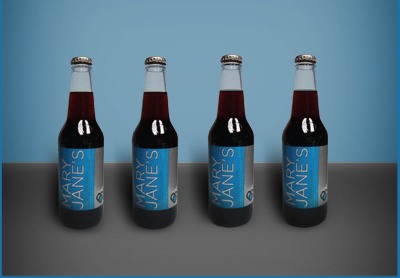
On the other hand, taking the Adam Curry view ‘o life, this could all be a covert government sponsored attempt to sedate the population.
In Los Angeles, where medical marijuana dispensaries outnumber Starbucks and McDonald’s restaurants combined, a mood-altering beverage with a cannabis-oriented marketing campaign is gaining traction. Southern California has become the bestselling market for Mary Jane’s Relaxing Soda, a sugary drink laced with kava, a South Pacific root purported to have sedative properties.
Matt Moody, a Denver nutritional supplement developer who created the beverage, said the name is an unabashed reference to weed, though the relaxant compounds in kava are chemically unrelated to those in marijuana.
Along with drinks like Slow Cow and Ex Chill, Mary Jane’s is part of a new group of so-called slow-down or anti-energy drinks, which are expected to be among the top food trends of 2010, according to advertising agency J. Walter Thompson.
They rely on folk-medicine sedatives, including kava, camomile and valerian, to provide an alternative to caffeine-laced and jitter-inducing energy drinks such as Red Bull.
[…]
These “relaxation” drinks have become popular fodder for food bloggers, with some calling Mary Jane’s “weed in a bottle.”
[…]
The calming effect is probably real, said Michael Pollastri, a pharmaceuticals chemist at Boston University.“If there were not therapeutic effects, it would not be a 1,000-year-old folk medicine,” Pollastri said.

Just remember a lot of trends like this start there and end up in America. How much are you willing to have your taxes go up to bail out the record and movie industries?
According to Labour Party leaders, the government is planning on handing the expense of the Digital Economy Bill down to taxpayers. That expense is estimated to be approximately £500M (approximately $800M USD). On average, that works out to more than £25 more a year ($40 USD/year) per internet connection.
And that’s considering that the government is counting on the bill reducing piracy enough to increase media revenues by £1.7B ($2.72B USD), leading to £350M ($560M USD) extra in VAT tax revenue. If that increase isn’t realized, British taxpayers could find themselves on the hook for over $1B USD in enforcement expenses.
The initial letter writing campaign is predicted to cut off 40,000 citizens from the internet and cost £1.40 ($2.20 USD) per subscription. The government appears to have purposefully neglects to include possible economic losses based on citizens being taken offline in its estimates.
“The exemptions included in the carbon tax run counter to the aim of fighting climate change and create inequalities with respect to public charges,” the Constitutional Council said in a statement. “93 percent of carbon dioxide emissions of industrial origin, other than fuel, will be totally exempt from the carbon tax,” the government body said in the ruling.
This shows that this global warming stuff has nothing to do with saving the planet — it’s just a money-making scheme.

It certainly looks like 2010 is shaping up to be the year during which 3D finally moves from the realm of novelty into both mainstream film and TV. Satellite cable provider DirecTV has a new satellite in the air, and according to HD Guru, one of the 200 new HD stations to be broadcast from it includes the first U.S. HDTV channel in 3D.
There are still some technical hurdles to clear before you’re watching zany sitcom antics flying toward you, but the trend is clear. The satellite begins full operation in March, and existing DirecTV set-top boxes will simply need a firmware upgrade to support the 3D programming. Unfortunately, you’ll still need to pick up a 3D-capable HDTV to play it back, and that’s where the market lag will play a role in determining how fast 3D will penetrate.

Sitting down for an after lunch snack turned into a brush with all things holy when Lisa Swinton saw the face of Jesus on her banana peel.
“I was like ‘Oh my God! It’s Jesus on a banana! I got it out of the fruit bowl and was about to peel it and eat it when I saw his face,” she told The Daily Telegraph.
The impact of seeing Christ pressed into the banana did not stop the 39-year-old of Haberfield from still eating the fruit and depositing the holy peel.
“I put some photos up on Facebook – one of my friends said it looked like a monkey.”
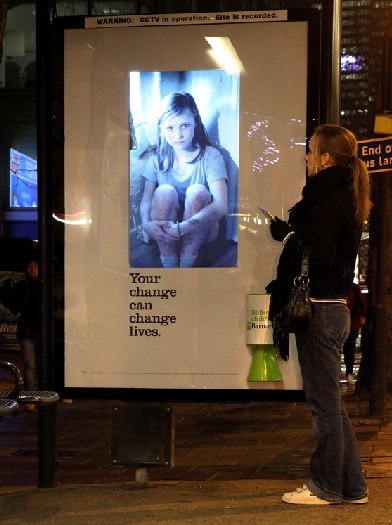
Is this the start of Minority Report-style, interactive advertising? Imagine this one going further: when you walk past without giving, the girl puts out her hand, her pleading eyes following you as she mouths the word “please.” In 3D.
The poster site features a film, shot by Frank Budgen, of a distressed-looking girl sitting alone in the corner of a room. At the bottom of the image is a traditional-looking collection tin that passers-by can place money into. When a coin is placed in the tin, the girl looks directly out of the frame at the person contributing and gives them a half-smile.
 For Kindle and with free ePub version. Only $9.49 Great reading.
Here is what Gary Shapiro CEO of the Consumer Electronics Association (CEA) said: Dvorak's writing sings with insight and clarity. Whether or not you agree with John's views, he will get you thinking and is never boring. These essays are worth the read!
For Kindle and with free ePub version. Only $9.49 Great reading.
Here is what Gary Shapiro CEO of the Consumer Electronics Association (CEA) said: Dvorak's writing sings with insight and clarity. Whether or not you agree with John's views, he will get you thinking and is never boring. These essays are worth the read!

Subscribe to Main Blog feed here:


Subscribe to Comments too (below):

Bad Behavior has blocked 10041 access attempts in the last 7 days.
